Postonomous Review: Can It Really Create, Score & Publish Your Content?
Postonomous looked like another AI content tool. Then I saw the Simulator.
Here’s my detailed look at what Postonomous actually does, where I think it could save time, what I would be careful about, and the 15 extra tools I’m including for buyers who come through this page.
Start the Review ↓POSTBUNDLE · click to copyMy quick answer
Postonomous is much more interesting than I expected from the words “AI social media tool.”
When I first looked at Postonomous, I thought I already knew the category. We have all seen tools that ask for a topic, produce a caption, add a few hashtags and then offer to schedule it. Useful? Sometimes. Exciting? Not really. There are already plenty of ways to make more AI-written content.
Then I got to the Simulator.
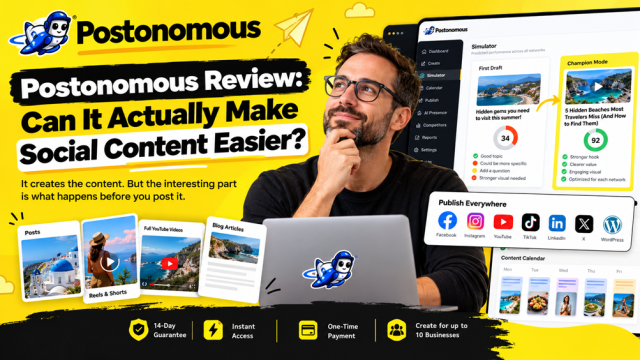
That is the part that made me slow down. Postonomous is not only trying to help you create a post. It is trying to give you a signal about the post before you publish it. The system uses AI personas to react to a draft, gives that draft a WinScore from 0 to 100, shows what may be helping or hurting it, and lets Champion Mode rewrite and retest the idea. The sales page is careful to say that WinScore is a signal, not a guarantee, and I think that is exactly the right way to look at it.
I would not buy any software because somebody says it can “predict virality.” Social media simply has too many moving parts for that kind of certainty. Timing matters. The audience matters. The platform matters. The strength of the idea matters. Luck still exists. But I would be interested in a tool that gives me another way to compare drafts before I put them in front of a real audience or spend money promoting them.
There is a lot more in the platform than the Simulator. The current sales material shows Brand Knowledge, a chat-based Creation Studio, social publishing, WordPress publishing, short-form and long-form video, talking presenters, voice cloning, competitor research, trend research, AI Presence tracking, agency features and connections for AI agents. That is a big list. It also means this review needs to be about more than repeating the feature bullets from the sales page.
So below I am going to walk through the pieces that matter to me, where I think they fit, what I would be cautious about, and who I think is most likely to get real use from the system. I am also including 15 tools of my own for buyers who come through this page, because there are strategy decisions that no content generator should be making for you automatically.
The problem Postonomous is trying to solve
Creating more content was never the whole problem.
The sales page makes a point that I think is fair: most content software helps at one particular stage. Writers help you create. Schedulers help you publish. Analytics tools tell you what happened after the post is already live. The awkward gap is the space between “this draft looks okay” and “let’s put it in front of the audience.”
Most of us handle that gap with instinct. We choose the hook we like. We pick the image that feels strongest. We decide which post deserves a boost. Sometimes our instinct is good. Sometimes the post dies quietly and we learn about the mistake after the fact.
Postonomous is built around the idea that this gap can be tested. The Simulator is supposed to let AI personas react to a draft before real people do. WinScore turns that response into a 0–100 score. Champion Mode can then take a weak draft, rewrite it and run it through the process again.
I like the logic of the workflow even if I keep my expectations sensible. I do not need a score to be a crystal ball for it to be useful. If I have three versions of an idea and the system can help me notice that one has a vague hook, another buries the point, and the third is much more specific, that is already useful information. The final call still belongs to me.
That is also why I would use the scoring feature differently depending on the situation. For an everyday organic post, I might use it as a quick second opinion. For a post I plan to put advertising money behind, I would spend more time comparing versions. For a brand-sensitive announcement, I would never let a higher score override accuracy or tone.
In other words, the Simulator is interesting because it adds another checkpoint. It does not remove judgment.
How the setup works
The starting point is your business, not an empty prompt box.
The first step shown on the Postonomous page is simple: paste your website. The platform says it pulls in your logo, colours, voice and business facts, then uses that information as Brand Knowledge. After that you connect the social channels you want to use and ask for the content you need in ordinary language.
This sounds like a small detail, but anyone who has used AI regularly knows how annoying context can become. You explain the company. Then you explain the audience. Then you explain the offer. Then you remind the model not to make up the opening hours. Tomorrow you start a new chat and do it again.
A shared brand layer makes sense because posts, images, videos and articles should all begin from the same facts. The current Postonomous material says the Brand Knowledge area can pull in the brand identity and facts, deep-scan your channels, and act as the information source that the generators read from.
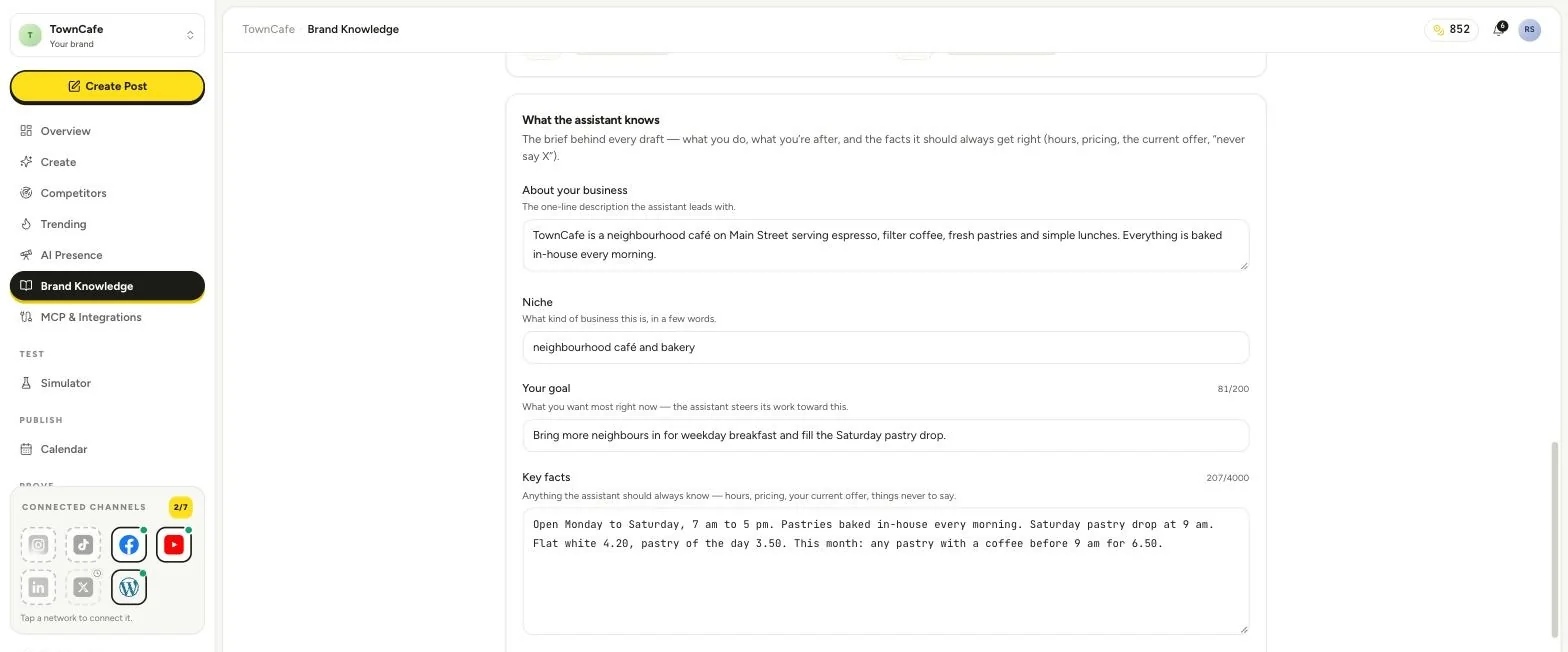
There is an important responsibility on the user here. A stored fact is only helpful if the fact is right. If your prices change, your hours change, an offer expires, or your positioning changes, the brand information needs to stay current. I would still check any important commercial claim before it goes live. “The AI knew my brand” is not a good excuse for publishing an old price.
For a single creator this saves repetition. For an agency it could matter much more, because every client has a different voice, offer, audience and set of facts. The current Bundle material specifically talks about multiple brands, so the separation between those brand brains is one of the first things I would test if I were buying for client work.
The Creation Studio
This is where Postonomous starts to feel less like a scheduler.
The Creation Studio is chat-first. Instead of jumping between separate tools for a post, an image, a video and a blog article, you can ask for the work from one place. The sales page describes one brief producing native posts for different networks, with brand voice controls and Champion Mode available inside the creation flow.
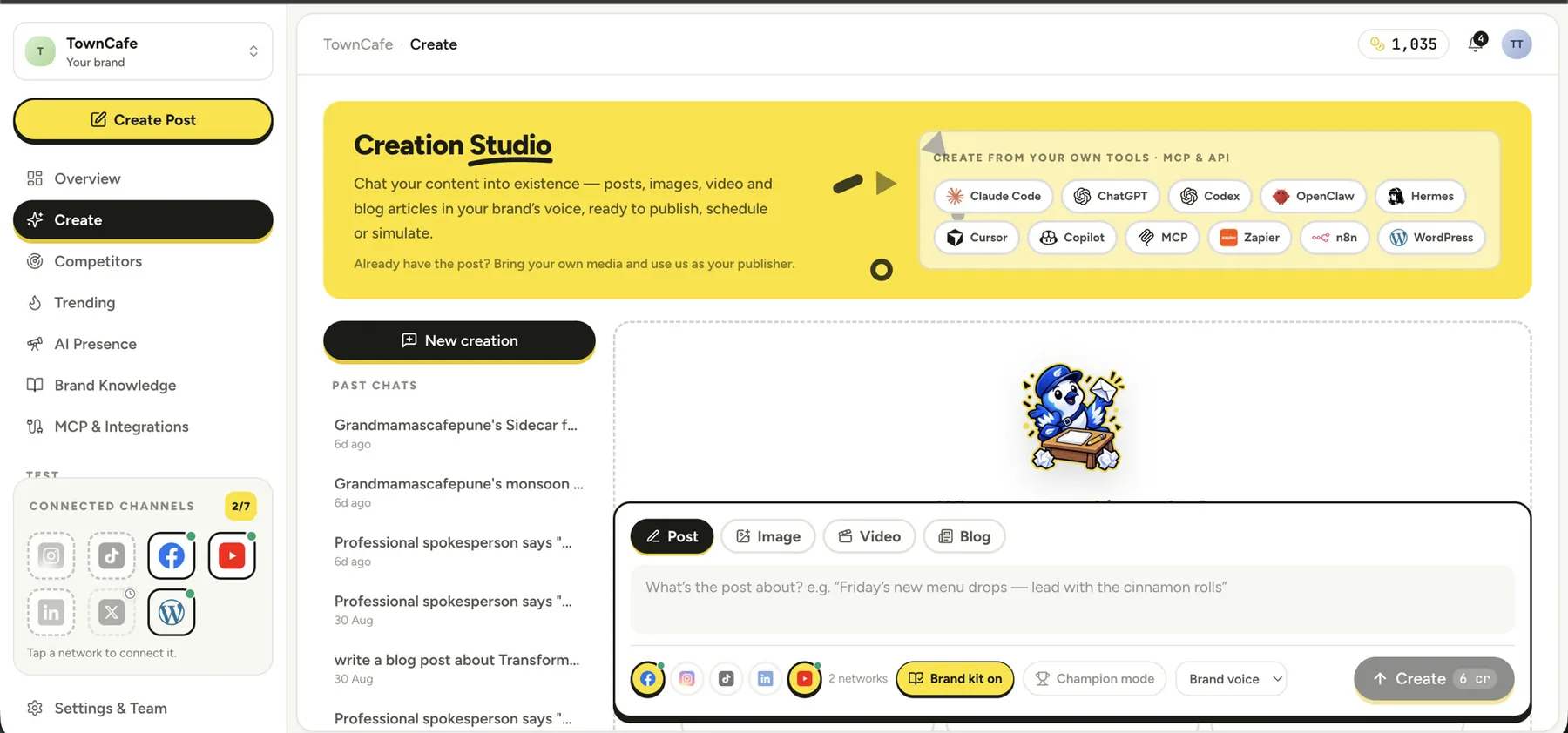
I prefer the idea of “native posts” to the old method of writing one caption and spraying it everywhere. A LinkedIn post and a TikTok script are not the same job. Even when the underlying idea is identical, the opening, pacing, length, format and call to action can be different. If the tool genuinely saves the idea while adapting the execution, that is more useful than basic cross-posting.
There is another side to this, though. More output can make it easier to publish mediocre ideas at scale. That is one reason I built the strategy bonuses further down the page. I want the machine doing the repetitive production work after I have thought about the audience, the angle and the purpose. I do not want “we can generate 30 posts” to become the strategy.
If I were evaluating the Creation Studio for myself, I would start with three very different requests: one educational post, one product-related post and one longer article. I would look at how well it preserves the brand facts, whether the platforms actually sound different, and how much editing I have to do before I would be comfortable attaching my name to the result.
Simulator, WinScore and Champion Mode
This is the feature I would test first.
The current sales page shows a simple example: a first draft scores 34, Champion Mode rewrites it, and the new version scores 92. Elsewhere the Simulator can compare two versions side by side and explain what appears to be helping or hurting each one.
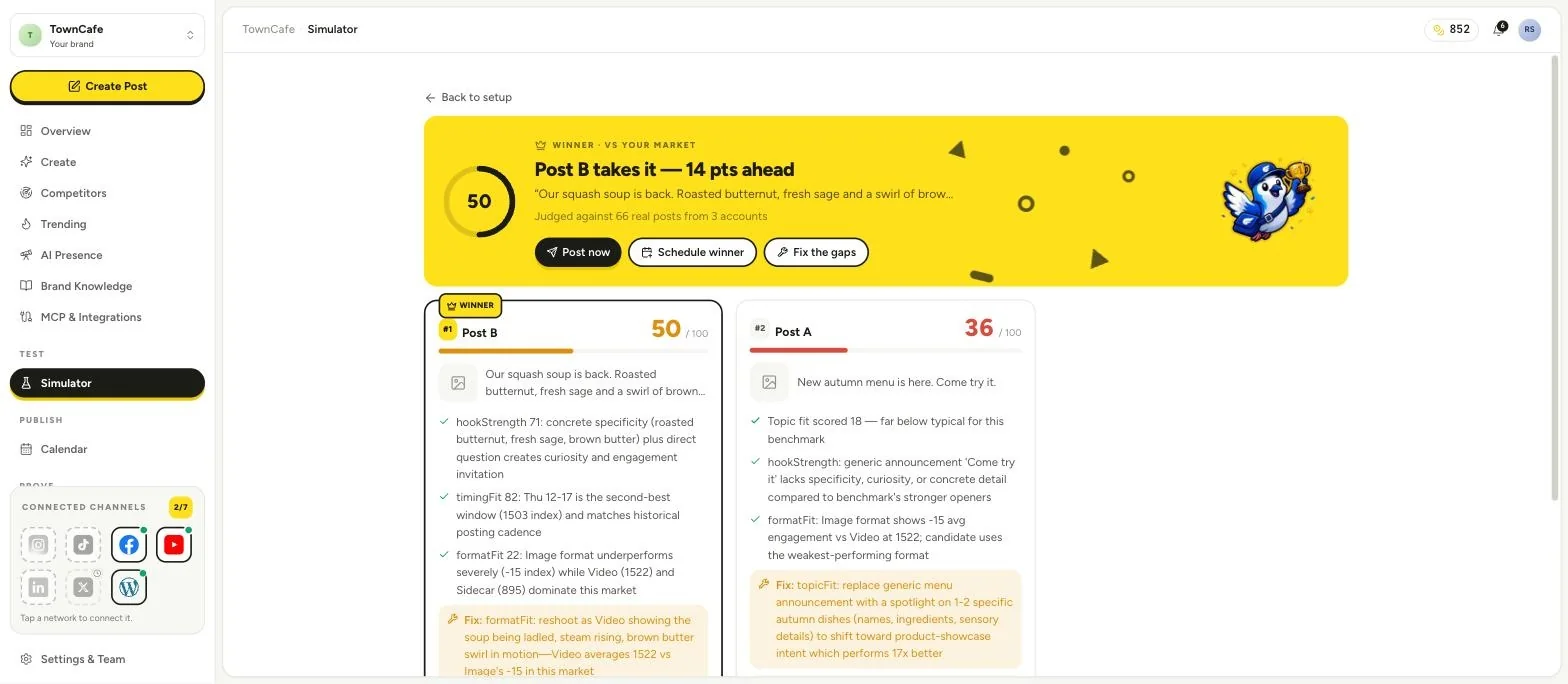
The idea is straightforward. You give the system a draft. AI personas react to it. WinScore summarizes the response and compares the draft against posts in the market. If you do not like the result, Champion Mode can rewrite and retest. You can also compare versions rather than judging them one at a time.
What I appreciate is that the vendor repeatedly includes the line that a WinScore is a strong signal, not a guarantee. That matters. Predictive systems can be useful without being perfect, but only if we resist turning a probability into a promise.
The sales page also points to research on AI personas and human reactions, including a September 2026 Scientific Reports study. I would treat that research as support for the broader idea that persona simulations can carry predictive information, not as proof that every Postonomous score will predict the exact result of every post. Those are very different claims.
How I would actually use it
I would use WinScore as a comparison tool more than a magic number. If Draft A and Draft B communicate the same idea differently, which one is clearer? If a promotional post is weak, what does the feedback say is missing? If Champion Mode improves the score, did it also preserve the truth, the brand voice and the point I wanted to make?
I would also keep a small record of predicted versus actual results. The sales material says the product can show predicted versus actual on posts. That is useful because it lets you learn how much weight to give the score in your niche. A signal that is useful for a café may behave differently for a B2B consultant or an affiliate review site.
And I would be particularly careful with advertising. Postonomous does not run the ads. The page positions WinScore as a way to decide which organic creative might deserve budget. That is sensible as a filtering step, but paid performance has its own variables: targeting, placement, offer, landing page, frequency and auction conditions. A strong post is not the whole ad campaign.
Video is not an afterthought
I expected posts and scheduling. I did not expect this much video.
This is probably the second area I would spend time testing. Postonomous currently shows a surprisingly broad collection of video formats: viral shorts, 15-second brand ads, whiteboard explainers, longer lessons, documentary-style videos, animated storybooks, spokesperson-plus-whiteboard videos, and a talking clip made from a single photo.
The sales page describes the basic idea as “one sentence in, finished video out.” In the examples, the app handles story, script, narration, visuals, on-screen text, music and call to action. Long-form video is shown at up to 10 minutes, and there is a character library designed to keep the same character consistent from scene to scene.
There are also features for cloning your own voice and for uploading an existing talking-head clip so the system can add b-roll, text treatments and synchronized captions. For creators who already record themselves but lose time in editing, that last feature may be more practical than generating a fully synthetic presenter.
Would I use every video style? Probably not. That is not a criticism. A local restaurant, an affiliate marketer, a coach and a professional services firm should not all look the same on video. Some brands can comfortably use animated characters and energetic vertical clips. Others will want a calmer presenter, a screen demonstration or a simple talking-head edit.
What matters to me is having choices inside the same workflow. If I can turn one well-planned idea into a post, a short video and a longer explanation without rebuilding the brand context every time, that can remove a lot of production friction.
I would still watch every generated video before publishing it. Check pronunciations. Check on-screen text. Check product claims. Check whether the visuals accidentally imply something that is not true. AI video has improved quickly, but “unedited output” is not the same thing as “no human review required.”
Publishing and the calendar
The automation stops before the final decision.
One detail I was glad to see is that the current page says nothing goes out until you press Post Now or Schedule. I prefer that to a system that treats “autonomous” as permission to publish anything it generates.
The supported social networks listed on the page are Facebook, Instagram, YouTube, TikTok, LinkedIn and X. WordPress publishing and scheduling is also included for articles. Publishing itself is listed as costing zero credits.
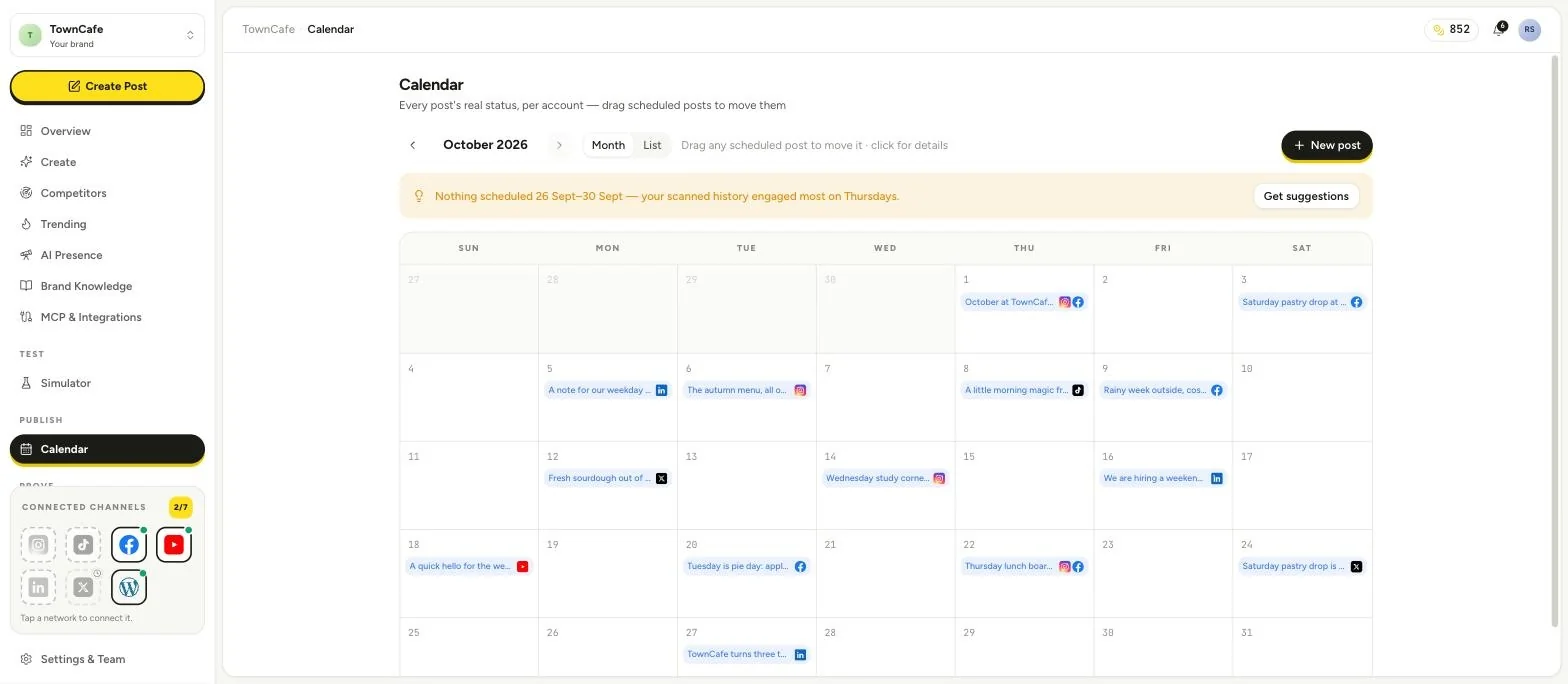
For an affiliate marketer, the WordPress part is especially interesting. A review article, supporting social posts and short videos can all be part of the same campaign instead of living in completely separate workflows. For an agency, the calendar becomes more important because approval and visibility matter almost as much as creation.
I would still resist filling every empty calendar square just because the software makes it easy. Consistency is useful. Noise is not. A content calendar should reflect what the audience needs and what the business is trying to achieve, not how many assets the AI can generate before lunch.
Competitors, trends and ideas
Research is useful. Copying your competitors is not.
Postonomous also has an intelligence side. The current product page shows competitor tracking, winning-post leaderboards, proven ideas, trend boards and niche keyword trend scans. There is also a “create my version” style workflow around ideas that are already working in the market.
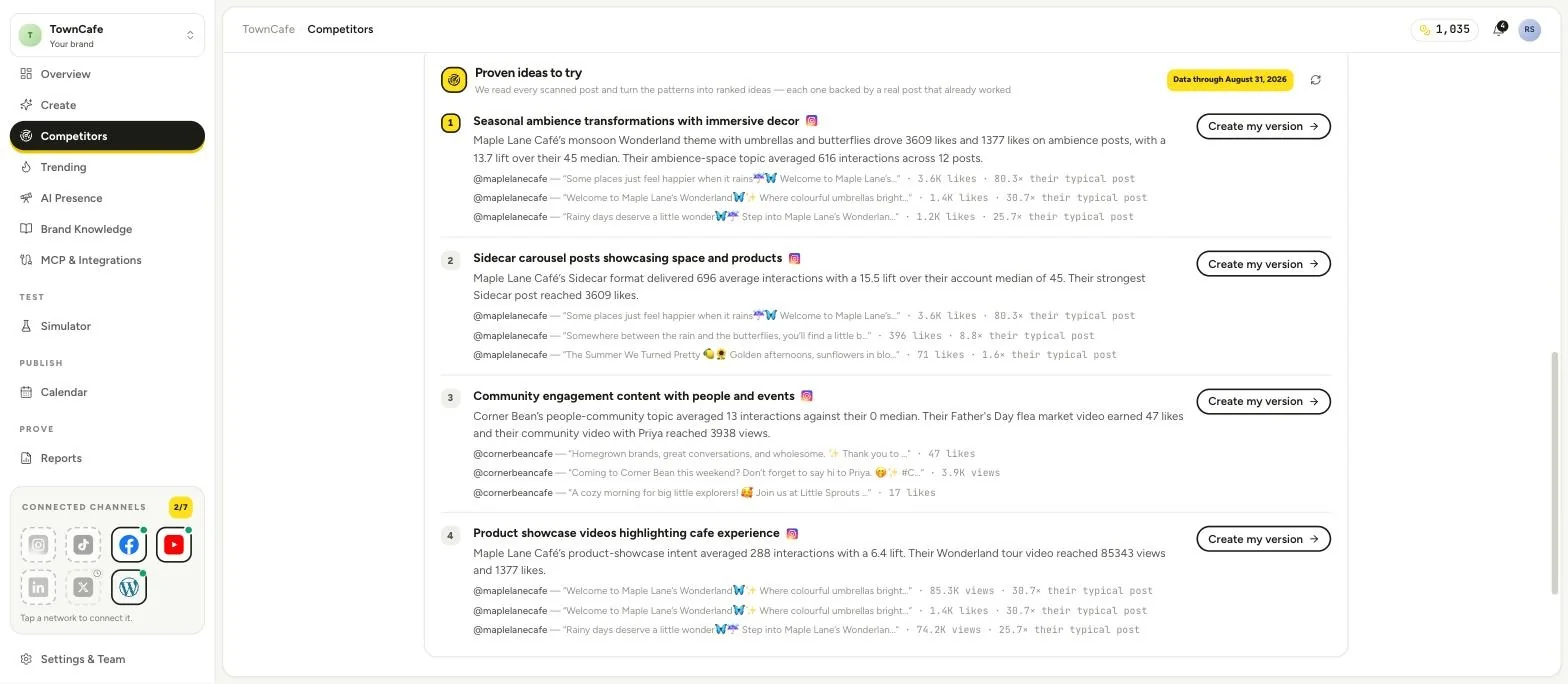
I can see the attraction immediately. One of the hardest parts of maintaining a content program is not writing the next post; it is deciding what deserves attention. Looking at the questions, formats and themes that are already getting a response can shorten that research process.
But I would use this as a pattern finder, not a copying machine. If a competitor’s carousel works because it explains a confusing buying decision, the lesson is not “make the same carousel.” The lesson may be that the audience wants help making that decision. Your job is to answer it with your own evidence, examples and point of view.
This is also where Brand Knowledge becomes important. Trend-driven content can become generic very quickly. The more the system knows about what is actually true and distinctive about your business, the better chance you have of turning a market pattern into something that belongs to you.
AI Presence
Postonomous is also looking at a question that barely existed a few years ago.
People do not only search Google anymore. They ask ChatGPT, Gemini, Perplexity, Claude and other assistants to recommend products, businesses and services. Postonomous calls its monitoring feature AI Presence.
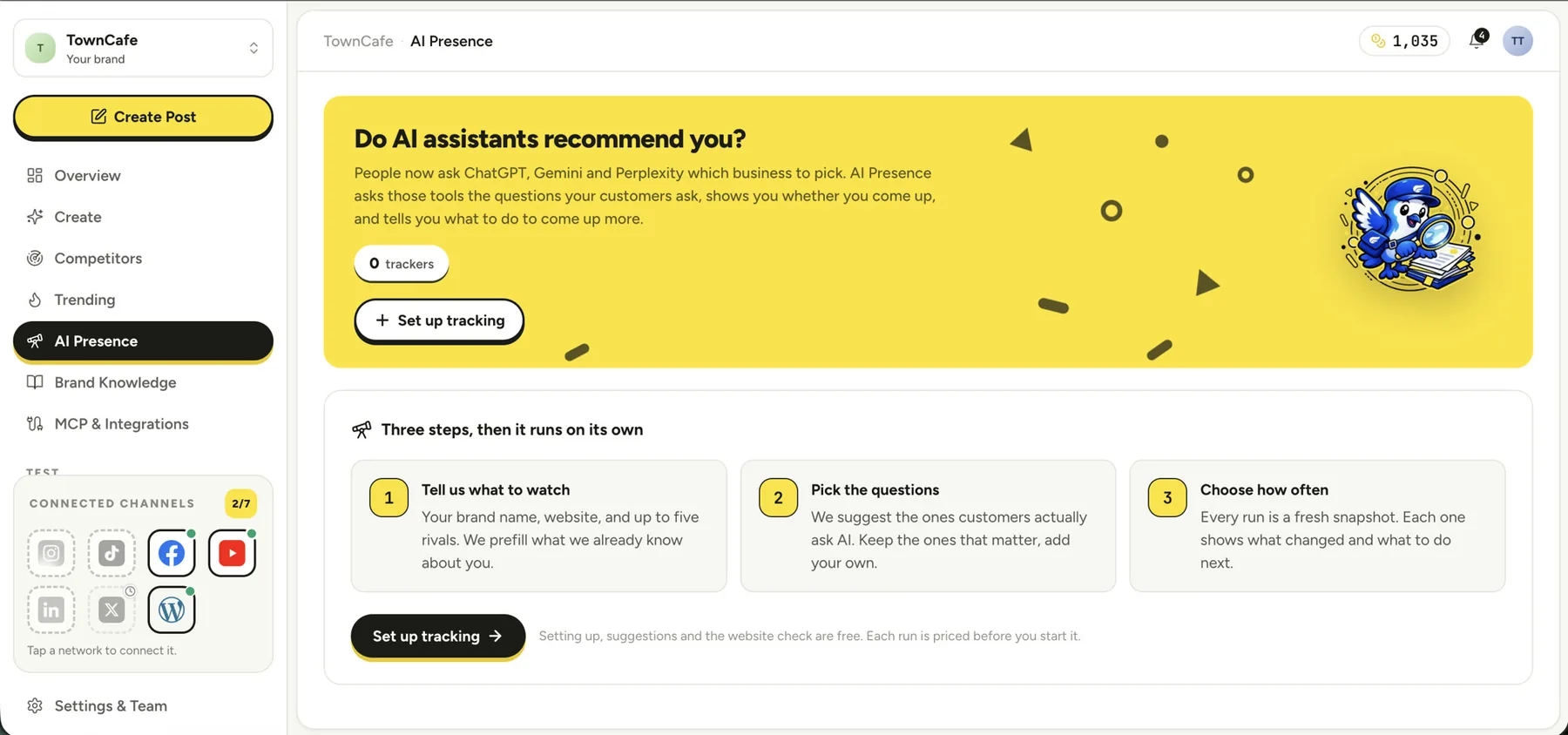
The current sales page says AI Presence can ask customer-style questions across six engines—ChatGPT, Gemini, Perplexity, Claude, Grok and DeepSeek—then show whether your business appears, who appears instead and where the answer got its information. It can run on a daily or weekly schedule. The Bundle is described as including five trackers and a digest email.
I would not obsess over one snapshot. AI answers can vary, and this whole area is still changing quickly. The more interesting use is watching the trend and looking for repeated gaps. If competitors keep appearing for a question and you never do, what information are they publishing that you are not? Are authoritative sources mentioning them? Is your own site clear about the service or category?
I like that this feature is connected to content creation because visibility problems often become content problems. But again, I would want the recommendation to be evidence-based. Creating ten pages just because an AI monitor says “write more” is not a strategy. The question is what useful information is missing and whether you can genuinely add it.
Who I think gets the most from it
The sales page lists seven types of users. Here is how I see them.
Local businesses
This may be one of the easiest use cases to understand. A local business owner is busy running the actual business. Social media gets squeezed between customers, staffing, stock and everything else. If the website can supply the core facts and Postonomous can help build a month of posts, images and videos around real offers and events, the time saving is easy to picture. The caution is keeping those facts current—especially hours, prices and limited-time offers.
Coaches and consultants
Experts often have plenty to say and very little desire to turn every idea into six content formats. The sales page specifically shows posts, blog articles, whiteboard lessons and spokesperson explainers for this group. The biggest opportunity is turning existing expertise into a repeatable content system. The biggest risk is letting generic AI language flatten the expert’s real point of view.
E-commerce
New products create a constant need for creative. Native posts, product-oriented short videos, brand ads and pre-publish comparison all fit that rhythm. I would be strict about product facts and visual accuracy. If a generated image changes the product, that is not a harmless creative flourish.
Agencies
The agency case is probably where the breadth of the platform matters most. The current Bundle material talks about 10 brands, separate Brand Knowledge, an unbranded client portal, read-only client logins, editor seats and white-label growth reports. If those are the features you need, consolidation can be worth more than any single generator. Agencies should test permissions, client approval and brand separation carefully before moving a live workflow over.
Creators
For creators, the editing tools may be the hook. The page specifically mentions taking your talking-head clip and adding b-roll, text treatments and synced captions, as well as a viral edit with jump cuts and captions. If filming is easy for you but editing is where the evening disappears, that is a very concrete problem to solve.
Affiliate marketers
This is the use case closest to this site. The original Postonomous page actually calls out affiliate marketers and describes review posts, shorts, blog articles, WordPress publishing and niche keyword trend scans. I can see the workflow: research what the market is talking about, plan the review angle, create supporting social content, produce short video, publish the article to WordPress, then schedule the campaign.
There is one thing I would never automate away: disclosure and judgment. An affiliate relationship should be disclosed. Product claims should be checked. A review should not pretend you personally used something if you did not. Faster production does not change those responsibilities.
Resellers
The sales material also describes a reseller use case with accounts to sell and vendor-side provisioning/support. That is a separate business model from using the software for your own content. If this is what interests you, read the current reseller terms carefully rather than assuming the economics from a headline.
Credits and the one-time-payment offer
“One-time payment” does not mean “unlimited AI forever.”
The current Bundle is presented as a one-time payment with no monthly fee, while 5,000 credits refill each month. The page also describes 10 brands in the Bundle. AI work such as generation uses credits; publishing and scheduling are listed as zero-credit actions. Unused credits do not necessarily behave like cash in an account, so read the current fair-use and credit information before planning a high-volume workflow.
I actually prefer that this is visible. Generative AI has real compute costs, especially video. The important question is not whether credits exist; it is whether the included monthly amount matches what you plan to make. Somebody creating mostly posts and occasional images will use the system differently from somebody trying to produce long-form video every day.
The launch material also advertises a 14-day guarantee. As always, the checkout and vendor terms are the source of truth for the guarantee that applies to your purchase. Launch pricing, coupons and package details can change, so I would verify them when you are ready to buy rather than relying on an old screenshot.
What I like
There are several things here I genuinely think are well thought out.
The workflow is connected. Brand context, creation, scoring, approval and publishing belong together. Even if you could reproduce every individual feature with separate tools, moving between them costs time and context.
The Simulator creates a useful pause before publishing. I like anything that makes me compare drafts rather than fall in love with the first one the AI gives me.
The product does not pretend social content is only text. Short video, longer video, presenters, voice, captions and editing are part of the same system.
Human approval remains in the loop. The current page says nothing is published until you choose to post or schedule it. That is exactly where I want the final decision to sit.
Brand Knowledge is practical. Remembering the business facts is not glamorous, but it is one of the differences between an AI toy and a workflow you can use repeatedly.
The affiliate and agency use cases are not an afterthought. WordPress publishing, multi-brand context, client features and market research make the platform more relevant to people managing more than one simple social account.
What I would be careful about
I would not buy Postonomous with unrealistic expectations.
A WinScore is not a promise. This is worth repeating because it is the easiest part of the offer to misunderstand. A predictive signal can improve a decision without guaranteeing the outcome.
More features mean more to learn. If all you need is a caption writer, this is a lot of product. The value comes from using several parts of the workflow.
Credits matter. Particularly if video is the main reason you are buying, check the current credit costs and estimate your likely monthly usage.
AI output still needs checking. Brand facts, claims, product details, names, pronunciations, disclosures and visual accuracy are still your responsibility.
Trend tools can encourage sameness. Use competitor data to understand the market, not to become a copy of the market.
Not every video style fits every brand. A fun AI character may be perfect for one audience and completely wrong for another.
Software does not create demand by itself. If the offer is weak or the audience is wrong, publishing faster will not fix the underlying problem.
See it for yourself
I’d watch the walkthrough before making a decision.
Feature lists are useful, but a product like this makes more sense when you can see the screens and the order of the workflow. The demo below is the one you supplied for this page.
My buyer bonuses
These 15 tools are here because Postonomous can create quickly—but you still need to decide what is worth creating.
I did not want to throw together a folder of generic PDFs just to make the bonus count look bigger. I built these as small interactive tools around the decisions I would want to make before and after using Postonomous.
For example, Postonomous can generate a strong-looking post, but it should not decide your entire positioning for you. It can help turn an idea into several formats, but that does not mean every idea deserves to be repurposed. It can make promotional content, but there still needs to be a believable bridge between the useful content and the offer.
That is what this package is for. If the individual prices shown below were purchased separately, they add up to $1,996. More important than the number is the way the tools fit around the main product.
Content Angle Miner
When the topic is obvious but the angle is not, this helps you approach it through pains, desires, objections, mistakes, curiosity and buying questions instead of producing another generic post.
HookLab Analyzer
A quick way to pressure-test the opening of a post for clarity, specificity, relevance and curiosity before handing the idea to your content workflow.
Content Pillar Architect
Build a small set of content pillars with a reason for each one, so your calendar is not just a collection of unrelated tips and promotions.
One-to-Many Content Mapper
Take one worthwhile idea and decide how it should change for LinkedIn, X, Instagram, video, email, blog and other channels instead of copying the same text everywhere.
Audience Pain Map Builder
Turn what you know about an audience into a working list of pains, desires, objections and questions that you can then validate against real conversations and feedback.
Brand Voice DNA Builder
Create a reusable voice profile covering tone, directness, detail, energy, phrases to use and phrases to avoid. It gives the AI something more useful than “make it sound professional.”
CTA Matchmaker
Match the next step to the reader’s stage and the purpose of the content. Not every post needs a buy-now button, and this tool helps you avoid forcing one in.
Content Gap Finder
Look at what you already publish and spot missing problem, method, proof, decision and action content. Useful when you feel like you are repeating yourself.
Social Offer Bridge Builder
Work out whether there is a genuine connection between the useful content and the product you want to recommend, then build the transition without turning the whole post into a pitch.
30-Day Campaign Architect
Map a month around a real objective, with room for diagnosis, education, trust, objections, decision content, action and review instead of posting whatever comes to mind that morning.
Repurpose Decision Engine
Decide what deserves another format, what needs updating first and what should simply be left alone. Repurposing everything is not automatically efficient.
Content Brief Generator Pro
Turn a rough idea into a production brief with audience, objective, format, evidence requirements, guardrails and CTA before the writing begins.
Objection-to-Content Engine
Take a real concern such as price, complexity, trust or fit and turn it into useful education, comparison, FAQ and decision-support content rather than an aggressive rebuttal.
Authority Story Builder
Shape real experiences, mistakes, observations and lessons into useful stories without inventing a dramatic personal history that never happened.
Campaign Postmortem Analyzer
After the campaign, separate what the numbers actually show from what you merely suspect. Then build a sensible next-test list instead of guessing again.
Understand the audience → find the angle → choose the content pillar → strengthen the hook → build the brief → create in Postonomous → repurpose deliberately → connect the offer → answer objections → publish → review the campaign → improve the next one.
A practical example
If I were using Postonomous for an affiliate campaign, this is how I’d approach it.
I would start outside the generator. First I would use Audience Pain Map Builder to write down the questions and objections I think the audience has, then check those ideas against comments, search queries, emails and real conversations. Next I would use Content Angle Miner to find several ways into the topic instead of defaulting to “here are the features.”
Once I had the angle, Content Brief Generator Pro would force me to decide what the piece is trying to do, what evidence I actually have and what I should not claim. If it is a review, I would be explicit about whether I personally tested the product or whether I am evaluating the vendor’s current material. That distinction matters.
Then I would take the brief into Postonomous. I could ask for a review-supporting social post, an image, a short video or a longer article draft. I would use the Simulator to compare hooks or versions, but I would not automatically choose the highest score if it became sensational or inaccurate.
After that I would use One-to-Many Content Mapper to decide which parts of the idea deserve a different treatment on each network. A short video might lead with the surprising feature. LinkedIn might focus on the workflow problem. An email might tell the story of why the feature matters. The review page itself would go deeper and carry the disclosures and buying details.
If the campaign generated objections—“I already use ChatGPT,” “I do not need another subscription,” “Will this work for my niche?”—I would put those into Objection-to-Content Engine and create useful follow-up pieces. Finally, after enough data came in, Campaign Postmortem Analyzer would help me write down what actually happened, what I only suspect, and what I should test next.
That is the relationship I want between the bonuses and Postonomous. The bonuses do not compete with the platform. They help me feed it better decisions.
Questions I would want answered
Postonomous FAQ
Is Postonomous just another AI writing tool?
No. Writing is part of it, but the current product also includes Brand Knowledge, pre-publish simulation and WinScore, Champion Mode, image/video creation, social publishing, WordPress publishing, competitor/trend research, AI Presence and agent integrations.
Does WinScore guarantee that a post will go viral?
No. The Postonomous sales page itself says WinScore is a strong signal, not a guarantee. I would use it to compare and improve drafts, then judge its usefulness against your own actual results.
What networks can it publish to?
The current page lists Facebook, Instagram, YouTube, TikTok, LinkedIn and X. It also lists WordPress publishing and scheduling for articles.
Can Postonomous publish without me approving the content?
The current sales material says nothing goes out until you choose Post Now or Schedule.
What kinds of video can it make?
The current page shows viral shorts, brand ads, whiteboard explainers, talking presenters, documentary-style video, animated storybooks, longer lessons, voice cloning and editing of uploaded talking-head clips, among other formats.
What is AI Presence?
It is the part of the platform designed to check whether AI assistants mention your business when asked relevant customer questions. The current Bundle description lists ChatGPT, Gemini, Perplexity, Claude, Grok and DeepSeek.
Is Postonomous a monthly subscription?
The current launch Bundle is presented as a one-time payment with monthly credit refills rather than a monthly subscription. Offer terms can change, so confirm the checkout details when you purchase.
What is the POSTBUNDLE coupon?
POSTBUNDLE is the Bundle coupon supplied for this launch. The code stays the same while the discount value may change during the launch. Check the current checkout to see what it applies today.
Do the 15 bonuses come from the Postonomous vendor?
No. They are my separate ePlanetJReviews buyer bonuses. I created them to cover audience research, content planning, offer connection, objections, repurposing and campaign analysis around the Postonomous workflow.
Are traffic, sales or income results guaranteed?
No. Neither Postonomous nor my bonuses can guarantee traffic, engagement, leads, sales or income. Your audience, offer, market, content, execution and many other variables affect the result.
My final take
Would I consider Postonomous?
Yes—if my real problem was the amount of work between having an idea and getting good, on-brand content out across several channels.
I would not buy it because I believe an AI can tell me with certainty what will go viral. I do not believe that. I would buy it because the Simulator gives me another way to compare drafts, Brand Knowledge reduces repetitive setup, the Creation Studio brings several asset types together, video is built into the same workflow, and publishing does not require me to move everything into another system.
The platform makes the most sense to me for people who will use several of those pieces. A local business that struggles to post consistently, a creator who loses hours to editing, an affiliate marketer publishing articles plus supporting social/video content, or an agency managing several brands can all make a reasonable case for consolidation.
If you only want a basic AI writer, I think you can find a simpler solution. If you publish occasionally on one network, the breadth may be unnecessary. And if you expect the software to invent your positioning, understand your customers without research, or guarantee performance, you are asking it to solve the wrong problem.
For the right user, though, I can see why Postonomous is getting attention. The most interesting idea is not that it creates content autonomously. It is that the product tries to put a quality check between creation and publication, then keep the rest of the workflow in the same place.
If that sounds useful to you, watch the demo, compare the current Bundle options below, check the credit limits against the way you plan to use the product, and make your decision from there.
Current affiliate links
Compare the Postonomous offers before you choose.
The launch coupon you gave me is POSTBUNDLE. The code stays the same, while the dollar value of the discount can change during the launch. I have not invented prices for the options below; use the checkout pages to confirm the current price, inclusions and terms.
Bundle
Postonomous Bundle
The main Bundle offer. Check the current checkout for today’s price and coupon value.
POSTBUNDLEClick to copy
Option 2
Mega Bundle
Use this link to see the current Mega Bundle configuration and compare it with the standard Bundle.
See Mega Bundle →Option 3
Mega Bundle Lite
Use this link to check the current Lite offer, limits and checkout price before deciding.
See Mega Bundle Lite →Coupon: POSTBUNDLE · discount value may change during launch
Don’t forget the Bundle coupon.
Use POSTBUNDLE where applicable. The code stays the same during the launch, although the discount value can change.
POSTBUNDLEIf you decide Postonomous is right for you, use the qualifying ePlanetJReviews affiliate link to be eligible for the 15-bonus package described on this page.
Check the Bundle Offer →