TubeOS X Review 2026: What It Does, Limits, Pricing, Bonuses
TubeOS X Review: I Looked Past the “AI YouTube Automation” Pitch—Here’s What Actually Matters
TubeOS X is being sold as a revenue-first YouTube operating system, not simply another AI video generator. That distinction is interesting. But it also creates a bigger question: does combining research, branding, video creation, affiliate offers, publishing and tracking actually make the workflow better—or just make the feature list longer?

I recommend reading the review before deciding. Pricing, launch bonuses and commercial-license terms can change; verify the current checkout.
The Interesting Part Isn't That It Makes Videos
There is no shortage of software that can write a script, generate images, synthesize a voice or assemble a short video. That is why I don't think “it makes AI videos” is a useful way to judge TubeOS X.
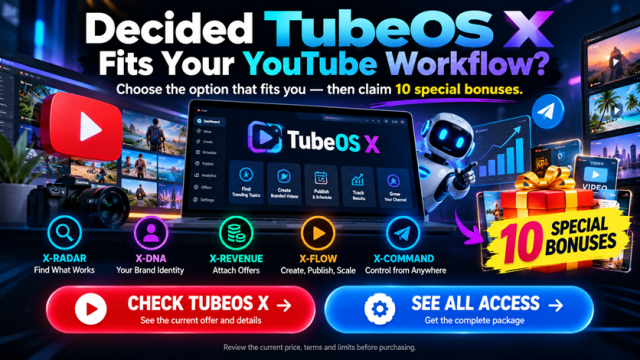
The more interesting idea is that the product tries to start before creation. According to the supplied campaign material, TubeOS X begins with topic, niche, keyword and competitor research, can surface matching affiliate offers, then carries that context into the script, visuals, voice, thumbnail, SEO, publishing and scheduling stages. The vendor organizes those jobs into five systems: X-RADAR, X-DNA, X-REVENUE, X-FLOW and X-COMMAND.
That matters because a technically polished video can still be commercially useless. You can make a good-looking video about a topic nobody is searching for, attach an irrelevant offer, publish it with a weak thumbnail, and then never look at the numbers again. Faster production simply lets you make that mistake faster.
My way of looking at TubeOS X is: it is trying to automate the connections between decisions, not merely automate editing.
That is a better proposition than “click once and get rich with YouTube.” It is also the standard I use throughout this review. I am less interested in how many AI features can be counted and more interested in whether each feature improves a real publishing decision.
Watch the vendor presentation
Official TubeOS X VSL. Treat performance and income statements in promotional material as vendor claims rather than guaranteed outcomes.
I Think TubeOS X Is Really Selling Workflow Consolidation
Imagine an affiliate marketer wants to make a review video about a new software launch. A normal workflow might start with YouTube and Google research, move into ChatGPT for angles and a script, use another tool for visuals, another for voice, an editor for scenes and captions, Canva for a thumbnail, a keyword tool for metadata, YouTube Studio for scheduling, and a spreadsheet or link tracker for results.
None of those tools is necessarily bad. In fact, a specialist tool may be better at its individual job. The problem is context switching. The audience you researched in step one can disappear by step five. The offer gets bolted on at the end. Branding changes between videos. A script optimized for explanation may not naturally lead to the product being promoted.
TubeOS X's thesis is that these jobs should share context. X-RADAR decides what looks worth making. X-DNA carries brand identity. X-REVENUE keeps the intended commercial outcome visible. X-FLOW creates and publishes. X-COMMAND lets you manage parts of the process through Telegram.
I can see the appeal. But consolidation is only valuable if the individual outputs are good enough. If you routinely rewrite every script, replace every visual and rebuild every thumbnail, “one dashboard” stops being a time saver. That is why I would use the demo and sample videos on this page to judge output quality for your niche rather than buying based on the architecture alone.
What Happens From Idea to Published Video
Find What Works, What Sells
The vendor says a Telegram message can surface topics, angles, audiences, keywords and competitors, plus matching affiliate offers from sources including JVZoo, WarriorPlus, DigiStore24, Explodely, LaunchPad and MunchEye. The useful part is not the size of that list; it is bringing content opportunity and monetization research into the same decision.
Create & Publish a Branded Video
TubeOS X is positioned to build the script, scenes, voice, captions, music and thumbnail around a recurring brand or character, then prepare SEO and publish or schedule. The key question is whether you use that as a draft workflow or accept everything automatically. I would strongly favor review before publishing.
Track and Decide What Deserves More
The supplied material describes scheduling up to 30 days ahead on the core offer and tracking views, clicks, traffic, sales and commissions. That feedback loop is potentially more useful than simply generating more content because it gives you a reason to stop repeating ideas that do not work.
This Is Probably Where I Would Start
One problem I have with many AI video tools is that they begin too late. They ask for a topic or script. If I already know exactly what to publish, that is fine. But topic selection is often the harder decision.
X-RADAR is TubeOS X's research layer. The supplied material describes idea discovery, niche and topic research, keyword opportunities, competitor inspiration and an Offer Finder. In practical terms, I would use it to build a shortlist rather than ask the software to make the final choice.
For example, suppose the channel is about AI marketing software. “Make a video about AI tools” is too broad to be useful. I would rather see specific questions people are asking, competitors already receiving attention, angles that are becoming crowded, and products that genuinely match those questions. Then I can choose a topic with both viewer value and commercial relevance.
There is an important limitation: an opportunity signal is not proof of demand. And finding an affiliate offer is definitely not a reason to recommend it. I would still inspect the product, pricing, sales claims and buyer fit manually. X-RADAR can shorten research; it cannot outsource reputation.
The “Generic AI Video” Problem Is Real—But Branding Is More Than a Character
X-DNA is the part I find conceptually strongest because it addresses a visible weakness of mass AI content: sameness. The campaign material says TubeOS X can store channel information such as branding, audience, tone, colors, keywords, goals and visual identity. It also includes an AI Character Builder, your own face/voice options, multiple script and visual styles, and character-based thumbnails.
A recurring character can help. A consistent voice can help. Repeating colors and thumbnail structure can help. But none of those automatically creates a brand. A brand also comes from what you notice, what you refuse to recommend, how you explain trade-offs and whether viewers can predict the quality of your next upload.
If I were using X-DNA for a review channel, I would not create a cartoon mascot and consider the job finished. I would define a repeatable editorial identity: perhaps every review begins with the buyer problem, shows the workflow, names one thing I like, one thing I distrust, and ends with who should skip it. Then the visual character and voice reinforce that editorial pattern.
TubeOS X can help make the channel look consistent. You still have to make the channel mean something.
The own-face and own-voice options are also interesting for creators who want recognizable identity without filming every scene. I would still be careful about unnatural delivery and would review pronunciation, emphasis and emotional tone before publishing.
Connecting an Offer Earlier Can Be Smart—As Long as the Video Doesn't Become an Ad
The vendor calls TubeOS X “revenue-first,” and X-REVENUE is the clearest expression of that idea. The supplied material describes an Offer Finder, offer attachment, monetization matching and script/CTA integration.
I like the sequencing. Affiliate marketers often make one of two mistakes. They create generic traffic content and later hunt for anything they can monetize, or they start with a product commission and force the entire video into a pitch. Neither is ideal.
A better sequence is: identify a real viewer problem, decide what useful video would solve part of it, then ask whether a product is a logical next step. If the answer is no, I would publish without the offer rather than damage the channel's trust.
Suppose the video is “3 ways to turn a blog post into a short video.” If the attached software genuinely handles one of those workflows, a CTA can be natural. But if X-REVENUE finds a high-commission product that only loosely matches, the commission should not win the argument.
That is the distinction I would keep in mind: X-REVENUE is useful for remembering the business objective. It should not be used to make every upload promotional.
Auto Mode vs Advanced Mode: I Would Not Use Them the Same Way
The core product material describes two creation paths. Auto Mode can take a simple instruction and move through topic, script, scenes, voice, thumbnail, SEO, offer integration and publishing. Advanced Mode lets you control topic, offer, script, casting, storyboard, scenes, visuals, voice, captions, music, thumbnail and publishing step by step.
Auto Mode is the feature that will attract people who want speed. I would use it for drafts, idea testing and lower-risk content. For a product review, comparison, financial claim, health-related topic, legal topic, or anything where factual precision matters, I would not treat “publish-ready” as “review-free.”
Advanced Mode is where the system becomes more interesting to me. AI speed is useful, but control over the storyboard, individual scenes and claims gives you somewhere to intervene. The supplied feature list also says scenes can be regenerated, prompts edited and your own media uploaded. That matters because the fastest way to make AI content look less generic is often to replace generic generated material with specific screenshots, demonstrations or evidence.
The same logic applies to voices, captions and music. Automation removes repetitive production work. It does not know whether a pronunciation makes your company look careless or whether a caption changes the meaning of a sentence.
Watch the quick walkthrough
Watch the Interface Before You Buy the Idea
A sales page can make a workflow sound effortless because it describes the outcome rather than the clicks. The product demo is where I would check whether the interface actually matches the way I work. Watch how topics are selected, where manual editing is possible, how much information must be entered, and what happens between generating a draft and publishing it.
My rule with AI creation software is simple: if the demo only impresses me when everything goes perfectly, I assume real projects will require more intervention. That is not necessarily a problem. I just want the intervention points to be accessible.
Telegram Control Sounds Like a Gimmick Until You Think About Approvals
“Run YouTube from Telegram” is an easy sales-page headline, but the useful part is more mundane. If you have videos being researched, generated, reviewed and scheduled, the ability to approve or manage jobs from a phone can reduce the need to reopen a desktop dashboard for every small decision.
I see this being more valuable to someone managing repeated production than to a person making one video a month. Agencies, multi-channel operators and creators who batch content are more likely to notice the convenience.
I would not use remote control as an excuse for remote-quality control. A phone screen is fine for checking a status or approving a known workflow. It is not where I want to verify tiny on-screen text, inspect a complex comparison chart or fact-check a detailed review.
What Can the Videos Look Like?
The sales page includes videos made in different styles and examples from affiliate partners. I selected three rather than embedding everything. The goal here is to judge pacing, visual consistency and whether the style fits the type of channel you want to build.
Paula Maree Roberts / affiliate-style example
TubeOS X sample video
TubeOS X sample video
Examples supplied as part of the TubeOS X promotion. They demonstrate possible styles, not guaranteed channel performance.
The Sales Page Shows Results—Here's How I Would Read Them
The TubeOS X sales page includes established-channel examples, beta-user statements and YouTube analytics screenshots. I think these are useful as context, but they answer different questions.
Large established channels such as the examples cited by the vendor can illustrate the importance of recognizable characters and consistent visual identity. They do not prove that TubeOS X caused those channels' success. Those brands existed independently and have their own history, teams, audiences and execution.
Beta-user screenshots and testimonials are more directly related to the product, but they still represent selected examples supplied by the vendor. I would not convert “someone achieved X” into “I should expect X.” What I want to learn from them is whether the workflow has been used in real campaigns and what type of outcome the vendor is trying to optimize.


How I Would Use TubeOS X for an Affiliate Review Channel
I would start with one product category rather than tell X-RADAR to find “anything profitable.” Suppose the category is AI video software. I would use the research layer to identify recurring buyer questions: pricing, alternatives, whether a tool supports long-form content, commercial rights, voice quality, export limits and so on.
Next I would choose one question with clear buyer intent and inspect the products that might answer it. I would not attach an offer until I had checked the sales page, terms and actual relevance. Once an offer passes that test, X-REVENUE can keep its benefits and CTA context available while the video is scripted.
Then I would use X-DNA to keep the channel identity consistent—same narrator or recurring character, stable visual language and a recognizable thumbnail system. In Advanced Mode I would replace generic scenes with product screenshots or demo footage wherever evidence matters. I would fact-check pricing and claims immediately before publishing.
Finally, I would schedule the video, track the resulting views and clicks, and compare it with other buyer-intent topics. If “Tool A vs Tool B” repeatedly earns qualified clicks while generic “Top 10 AI Tools” videos do not, that is useful feedback. The goal is not simply to schedule 30 days of content. It is to learn which content deserves the next 30 days.
That is the workflow where TubeOS X makes the most sense to me: research → editorial choice → branded creation → relevant offer → human review → publish → measure → adjust.
What the Features Change—and What They Don't
| Capability | What it may improve | What it cannot guarantee |
|---|---|---|
| X-RADAR / research | Faster idea, keyword, competitor and offer discovery. | That a topic will rank, go viral or convert. |
| X-DNA / characters / brand memory | Consistency across voice, visuals and thumbnails. | That viewers will trust or remember the brand. |
| X-REVENUE / offer integration | A clearer path from content to relevant CTA. | That an offer is good, ethical or right for the viewer. |
| Auto Mode | Fast first-pass production. | Factual accuracy or editorial quality. |
| Advanced Mode | More control without abandoning AI assistance. | That every generated scene or script choice is usable. |
| SEO engine | Metadata preparation and keyword organization. | Search ranking or recommendation traffic. |
| 30-day scheduling | Consistency and batching. | That publishing more frequently improves results. |
| Telegram control | Convenient remote approvals and management. | That complex quality checks should be done on a phone. |
Automation Is Useful. Publishing Without Review Is Not.
Before any TubeOS X-generated video went live on a channel I cared about, I would check the opening hook against the actual promise of the video; every factual or numerical claim; product pricing and terms; affiliate disclosure; pronunciations; captions; visual mismatches; whether the thumbnail accurately represents the video; whether the CTA fits the viewer's problem; and whether the video adds something beyond generic AI summary content.
I would also check whether any generated “proof” or example could be mistaken for my own result. This matters especially in affiliate marketing, where the difference between explaining a vendor claim and adopting it as your own claim is significant.
That manual layer is not a weakness unique to TubeOS X. It is simply the reality of using generative systems for public-facing content. The better question is whether the software reduces enough repetitive work that the remaining human review is worth doing.
Creating More Videos and Getting More YouTube Traffic Are Not the Same Job
This is one place where I would resist the most aggressive interpretation of the sales copy. TubeOS X can help with research, metadata, thumbnails, content production and consistency. Those are inputs. YouTube distribution is an outcome controlled by viewer behavior and the platform's systems.
A channel still needs topics people care about, titles and thumbnails that earn the click without misleading, videos that hold attention, and enough audience fit for YouTube to learn who should see the content. Search optimization can help discovery, but no SEO generator can guarantee a ranking.
So I would buy TubeOS X for workflow leverage, not for a promise of automatic traffic. If the workflow lets you test better ideas faster and learn from results, that can be valuable. If you expect the software to manufacture demand for weak topics, you are likely to be disappointed.
Three Buyers I Think Get More From TubeOS X Than Others
The Affiliate Video Publisher
You already promote software or digital products and want content research and offer selection to happen in the same workflow. X-RADAR + X-REVENUE are more relevant to you than they are to a hobby creator.
The Faceless Channel Builder
You want a recurring visual/voice identity rather than a stream of unrelated AI clips. X-DNA and Advanced Mode are the parts I would inspect most closely.
The Multi-Channel Operator
You batch production, manage several channels or work with clients. Scheduling, remote control and the higher-tier channel/team limits become more meaningful at that scale.
Which Version Would I Actually Consider?
The supplied launch material lists the front end at $27–$37. TubeOS X Pro is listed at $67, MasterMode at $97, ViralCred AI at $47, ClickAgent AI at $47, and the Reseller Licence at $297–$397. Those are supplied launch figures, not a promise that checkout will still show them when you visit.
| Offer | Supplied price | What changes | My decision lens |
|---|---|---|---|
| TubeOS X FE | $27–$37 | Core research, branding, creation, monetization, publishing and Telegram workflow. | Logical place to start if you are testing the workflow itself. |
| TubeOS X Pro | $67 | Up to 10 channels, unlimited script/SEO/scene/thumbnail generation per supplied material, 100+ voices, 10-minute videos, 1080p and tracking links. | More relevant when FE limits become a real constraint—not merely because “unlimited” sounds attractive. |
| MasterMode | $97 | 10 team members, up to 30 channels, workspaces, 90-day scheduling, videos up to 20 minutes and extra templates. | Primarily a scale/team decision. |
| ViralCred AI | $47 | Separate Facebook-oriented content/credibility system. | Not required simply to use TubeOS X for YouTube. |
| ClickAgent AI | $47 | Separate AI selling-room product. | Evaluate as its own sales/conversion tool. |
| Reseller | $297–$397 | Up to 100 client accounts and reseller assets per supplied material. | Only makes sense if reselling software is actually part of your business. |
The All Access path is attractive if you have already decided you need several upgrades. It is not automatically the better purchase simply because the stacked retail value is larger. I would compare the features I will use in the next 90 days, not the features I might use “one day.”
Four Questions I Would Answer Before Paying
1. Is YouTube already part of my next 90 days? If the answer is “maybe,” software is unlikely to create the habit for you.
2. Which tools or steps would TubeOS X actually replace? Write them down. If the answer is none, consolidation is not saving you anything.
3. Am I willing to review AI output before publishing? If not, the speed advantage can become a quality problem.
4. Do I need the front end, or am I already operating at Pro/MasterMode scale? Buy for current workload, not aspirational workload.
If You've Already Decided TubeOS X Fits, Here Are the 10 Bonuses

VideoShare Pro
$97 stated valueA responsive WordPress video theme for publishing videos from multiple sources, with theme controls, video options, ratings, social sharing and demo import.

Social Stream for WordPress
$97 stated valueCombines Facebook, Instagram, Twitter/X and YouTube feeds into a responsive website grid with caching and interactive viewing.

PixelPlay
$97 stated valueAdds customized thumbnail overlays and autoplay functionality to embedded YouTube, Vimeo and custom videos via WordPress.

Orbia
$97 stated valueAn Elementor-friendly WordPress theme aimed at AI agencies, SaaS, IT and technology businesses.

Pmotion
$97 stated valueA WordPress motion-graphics editor for animated GIFs and videos, with templates, animated text and Pexels/Pixabay integrations.

How To Research Profitable Niches
$97 stated valueA niche-research guide covering evergreen markets, segmentation, the 3-Question Method and keyword research.

60-Minute Traffic Masterclass
$97 stated valueTraining around fast content ideation, Hook–Value–CTA structure and audience/community traffic methods.

Invisible Income
$97 stated valueA guide to faceless online-service models such as writing, virtual assistance, design, support and ghost-creative work.

YouTube Advertising
$97 stated valueA report covering YouTube ad fundamentals, campaigns, targeting, audiences, budgets and ad types.

YouTube Influencer
$97 stated valueA guide to channel growth, engagement, audience building, affiliate monetization, branding and influencer strategies.
How to Claim the ePlanetJReviews TubeOS X Bonus Package
Purchase TubeOS X through the ePlanetJReviews promotional link, save your purchase receipt, and email proof of the qualifying purchase to support@eplanetjreviews.com. After verification, private access instructions can be sent to you.
Privacy: do not post receipts, order numbers, passwords, card details, banking credentials or other sensitive purchase information in a public group or WhatsApp chat.
Decided TubeOS X Fits Your YouTube Workflow?
Check the current offer and terms, then choose the purchase path that matches the way you will actually use the software.

TubeOS X FAQ
Is TubeOS X just an AI video generator?
No. The supplied material positions it as a wider workflow covering research, brand identity, video creation, offer integration, publishing, scheduling and remote control.
Does TubeOS X guarantee YouTube traffic or rankings?
No. It can assist with topics, SEO metadata, thumbnails, creation and publishing, but ranking and distribution depend on many factors outside the software.
What is the difference between Auto Mode and Advanced Mode?
Auto Mode is designed to move from a simple instruction through much of the workflow automatically. Advanced Mode gives control over elements including topic, script, casting, scenes, voice, captions, music, thumbnail, offer and publishing.
Can I use my own face or voice?
The supplied product material says X-DNA includes own-face and voice options in addition to recurring AI characters and a voice library.
Should I start with Pro or MasterMode?
Not automatically. Pro and MasterMode mainly make sense when their extra channels, output, resolution, team, scheduling or video-length capabilities solve a real limit in your workflow.
Are the result screenshots typical?
No typical-result assumption should be made. They are vendor-provided examples. Your outcome can differ substantially.
Should I buy TubeOS X just for the 10 bonuses?
No. Decide whether TubeOS X itself is suitable first. The bonuses are additional resources for qualifying purchases through this promotion.
Still Comparing TubeOS X?
Check the current vendor offer and confirm the price, limits and terms for yourself. If the workflow doesn't solve a problem you actually have, skip it.