BrowserAgent Review (2026): Features, Pricing, OTOs, Bonuses & Buyer’s Guide

BrowserAgent Review 2026: Features, Pricing, OTOs, Bonuses & Final Verdict
This complete BrowserAgent buyer’s guide explains what BrowserAgent is, how it works, who it is best suited for, what the pricing and upgrades include, and whether it fits your workflow.
This review avoids fake testing claims, fake income screenshots, fabricated testimonials, and unsupported performance results. It is built from official launch information, funnel details, demo information, and independent analysis.
Quick Facts
- Product: BrowserAgent
- Category: AI browser automation software
- Front-End Price: $37 one-time
- xBundle: $267/year with coupon BROWSE
- Regular Bonus Value: $1,398
- Total Value With Fast-Action Bonus: $2,395
BrowserAgent In Plain English
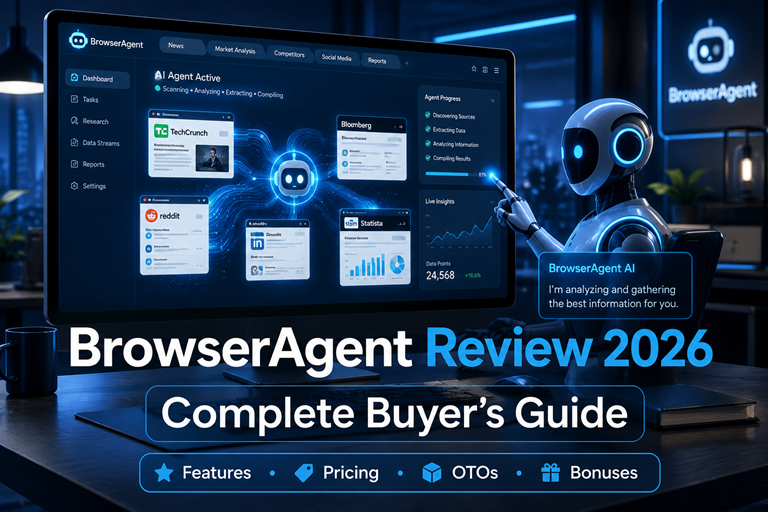
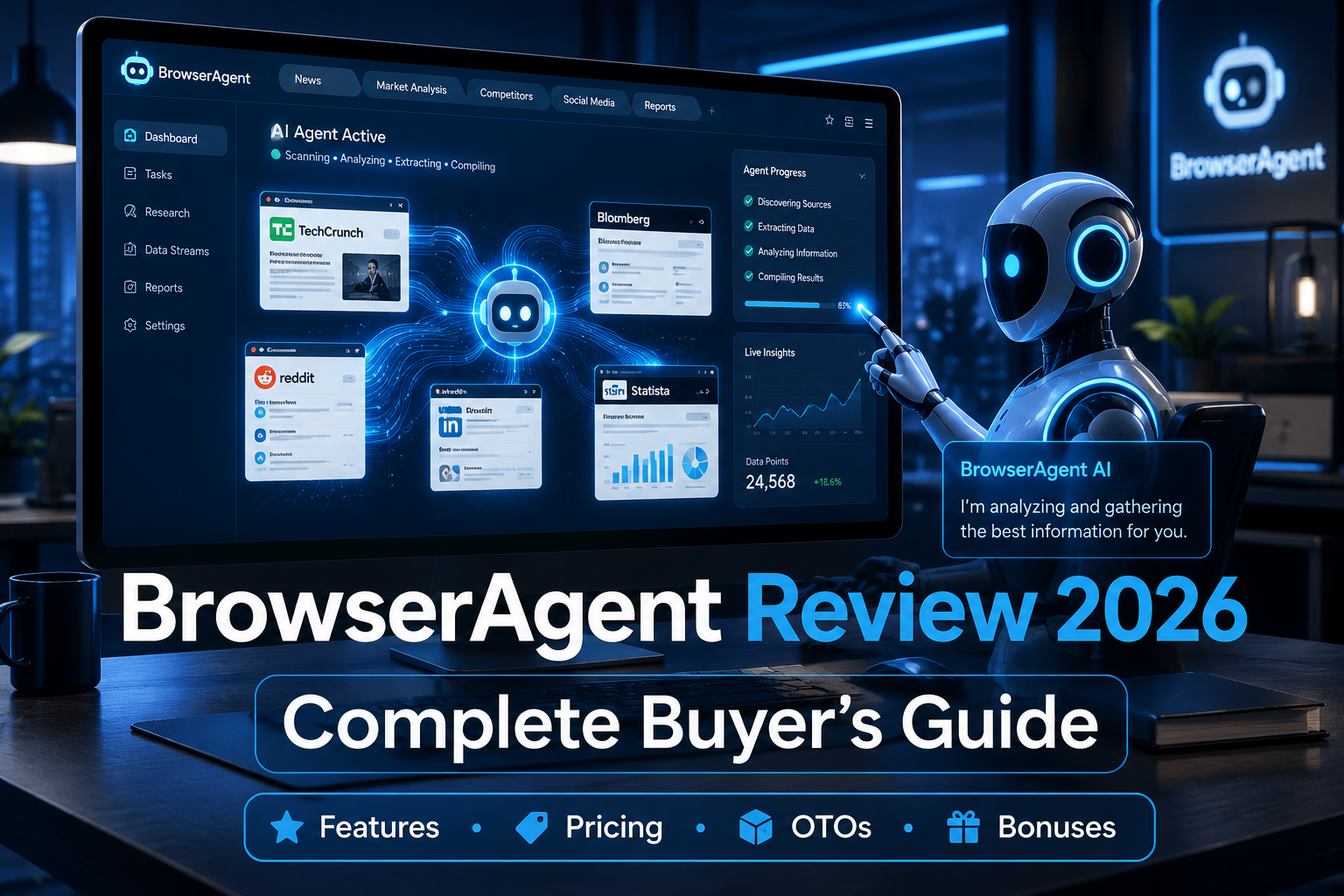
BrowserAgent is positioned as an AI-powered browser automation platform. Instead of functioning only as a chatbot or content generator, BrowserAgent is designed to perform browser-based workflows inside a hosted browser environment.
The practical idea is simple: users give BrowserAgent a mission, the system opens and controls a browser session, performs the browser work, and returns organized results that can be reviewed, exported, or used in a business process.
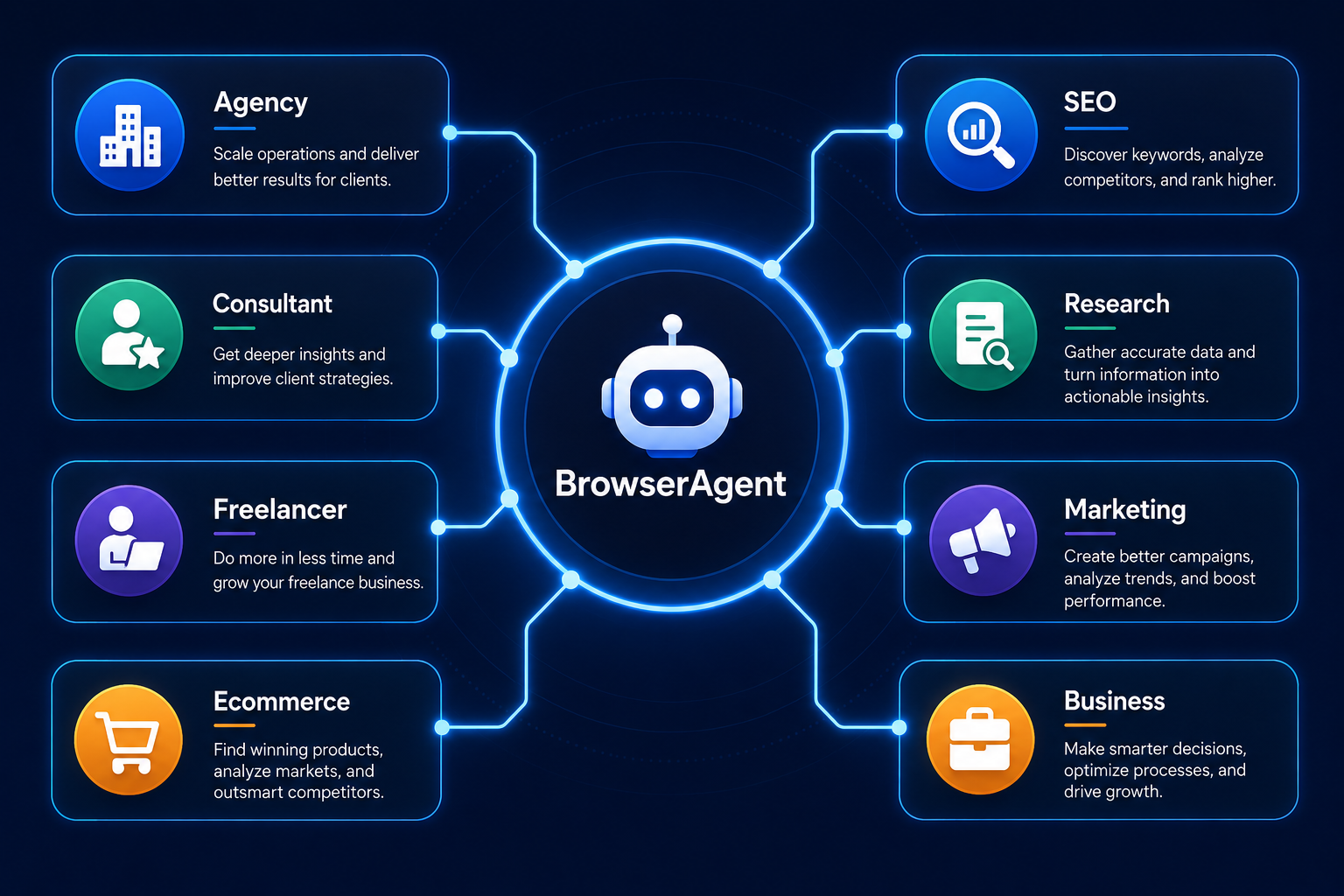
This makes BrowserAgent most relevant for people who repeatedly perform browser-based tasks such as research, website reviews, competitor monitoring, lead discovery, local SEO checks, report preparation, and business intelligence.
BrowserAgent Pre-Launch Webinar & Cart Open Details
BrowserAgent officially launches on Tuesday, June 30, 2026. Before the cart opens, the vendor is hosting an official pre-launch webinar where attendees can see the platform, understand how it works, and review the launch offer before making a buying decision.
🎥 Pre-Launch Webinar
Date: Tuesday, June 30, 2026
Time: 10:00 AM EST
The webinar is expected to cover the BrowserAgent overview, official demonstration, use cases, mission examples, launch details, and offer information.
🛒 Cart Opens
Date: Tuesday, June 30, 2026
Time: 11:00 AM EST
The BrowserAgent cart opens one hour after the webinar begins. At that time, buyers can access the front-end offer, bundle options, optional upgrades, and available launch bonuses.
The BrowserAgent cart opens one hour after the webinar begins. At that time, buyers can access the front-end offer, bundle options, optional upgrades, and available launch bonuses.
Bundle Coupon Code: BROWSE
BROWSE, reducing the xBundle offer to $267/year during the launch promotion. Pricing, coupon availability, bonuses, and launch promotions may change after the launch period, so always verify current offer details on the official checkout page before purchasing.
Complete BrowserAgent Buyer’s Guide
What Is BrowserAgent?
BrowserAgent is positioned as an AI-powered browser automation platform. Unlike traditional AI tools that mainly generate text, BrowserAgent is designed to perform browser-based workflows using a hosted browser environment.
In simple terms, BrowserAgent is built for tasks that normally require a person to open a browser, visit websites, click around, collect information, review pages, organize findings, and prepare results.
Instead of asking an AI chatbot for an answer and then doing the browser work yourself, BrowserAgent is designed to help complete the browser portion of the workflow. That is what makes it different from most general AI tools.
BrowserAgent At A Glance
- AI browser automation platform
- Hosted browser environment
- Natural-language mission execution
- Live browser workflow visibility
- Ready-to-run mission library
- Scheduling for recurring workflows
- Commercial rights included on the front-end offer
Why AI Browser Agents Matter
Most AI tools help with thinking, writing, summarizing, or brainstorming. Those are useful functions, but they do not always complete the practical browser work that businesses perform every day.
Many professionals still spend hours each week performing repetitive browser tasks such as opening websites, checking competitor pages, reviewing listings, collecting prospect information, checking reviews, preparing reports, and monitoring market changes.
These tasks are often not difficult, but they are repetitive. They also consume time that could be used for analysis, strategy, client communication, or revenue-generating work.
Traditional AI vs Browser-Based AI
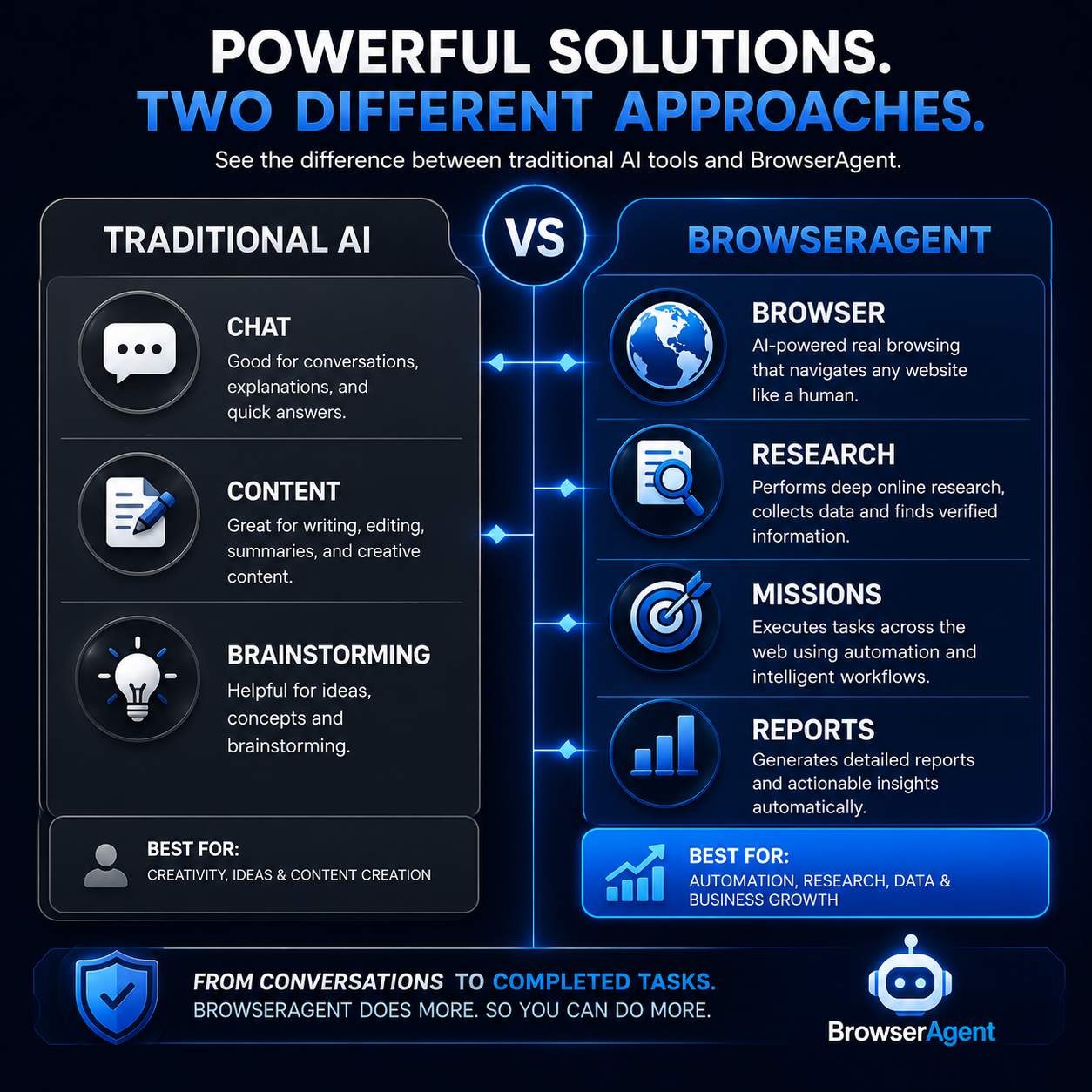
| Traditional AI Assistant | BrowserAgent-Style Browser Workflow |
|---|---|
| Generates text or answers questions | Focuses on browser-based workflow execution |
| User still opens sites manually | Browser session is part of the workflow |
| Best for writing, planning, and ideation | Best for research, monitoring, reporting, and browser tasks |
How BrowserAgent Works
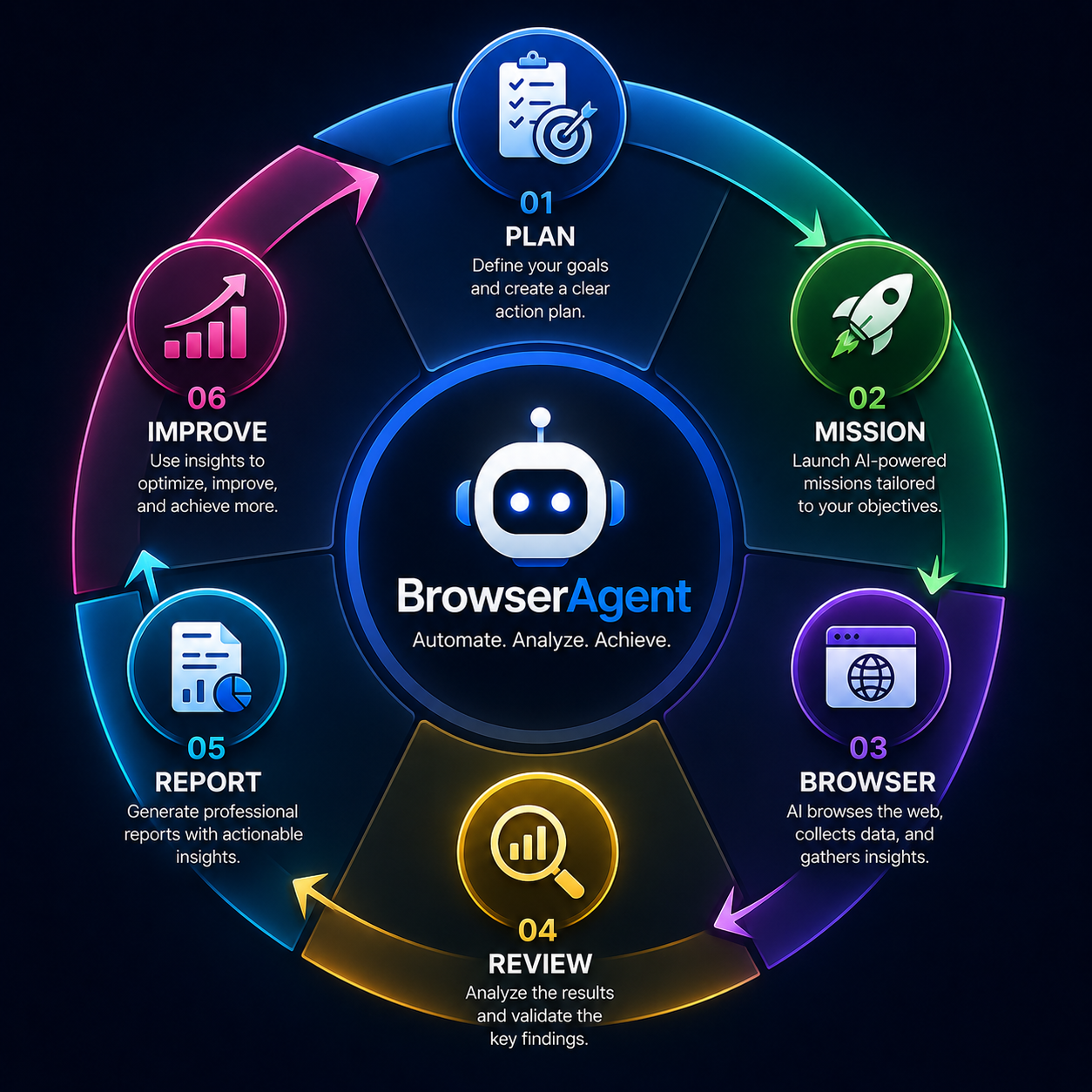
BrowserAgent works through what the launch materials describe as missions. A mission is a structured browser workflow designed to complete a specific objective.
Examples of mission-style objectives may include researching competitors, preparing a local SEO audit, collecting publicly available business information, monitoring websites, or organizing findings into a report.
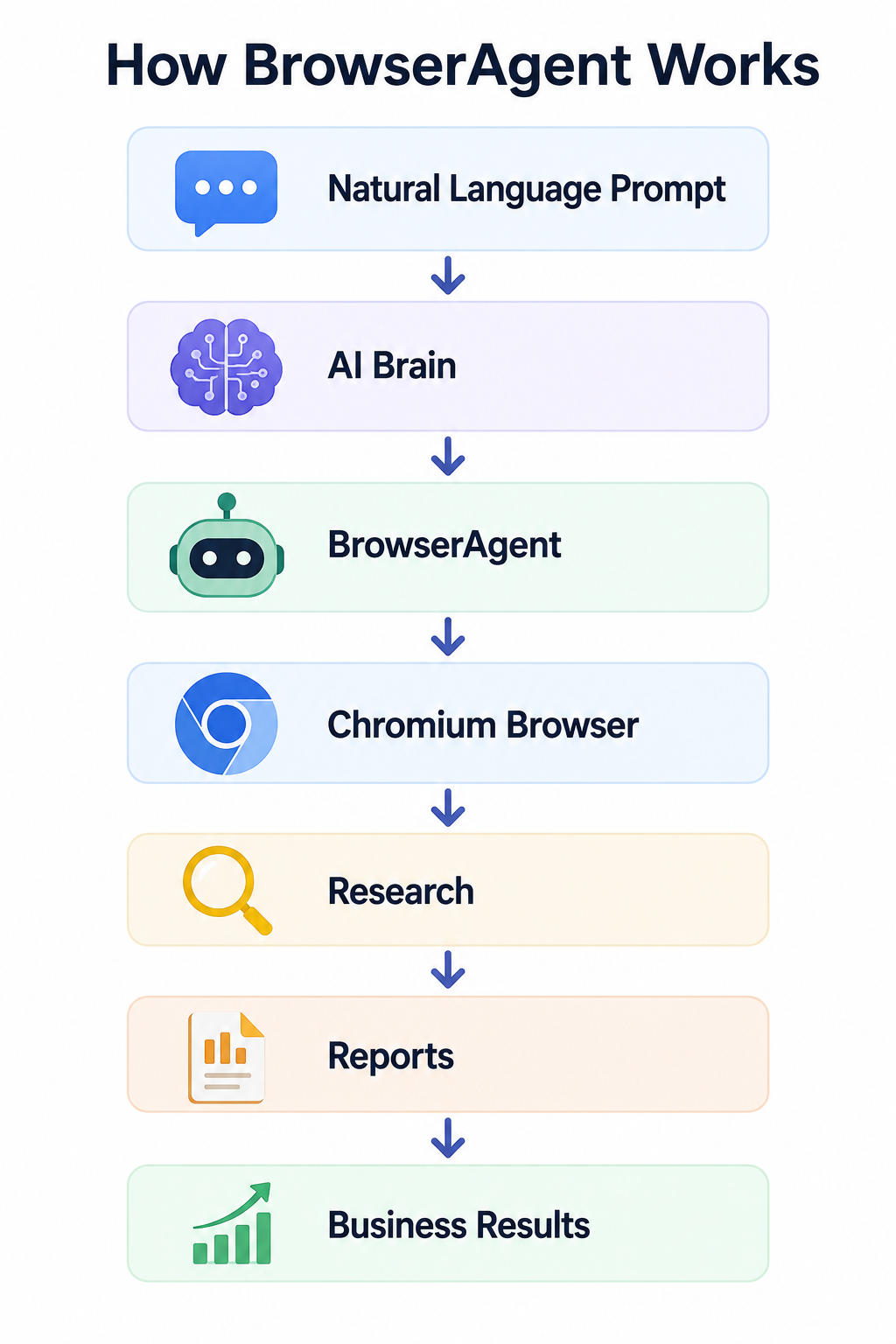
Typical BrowserAgent Workflow
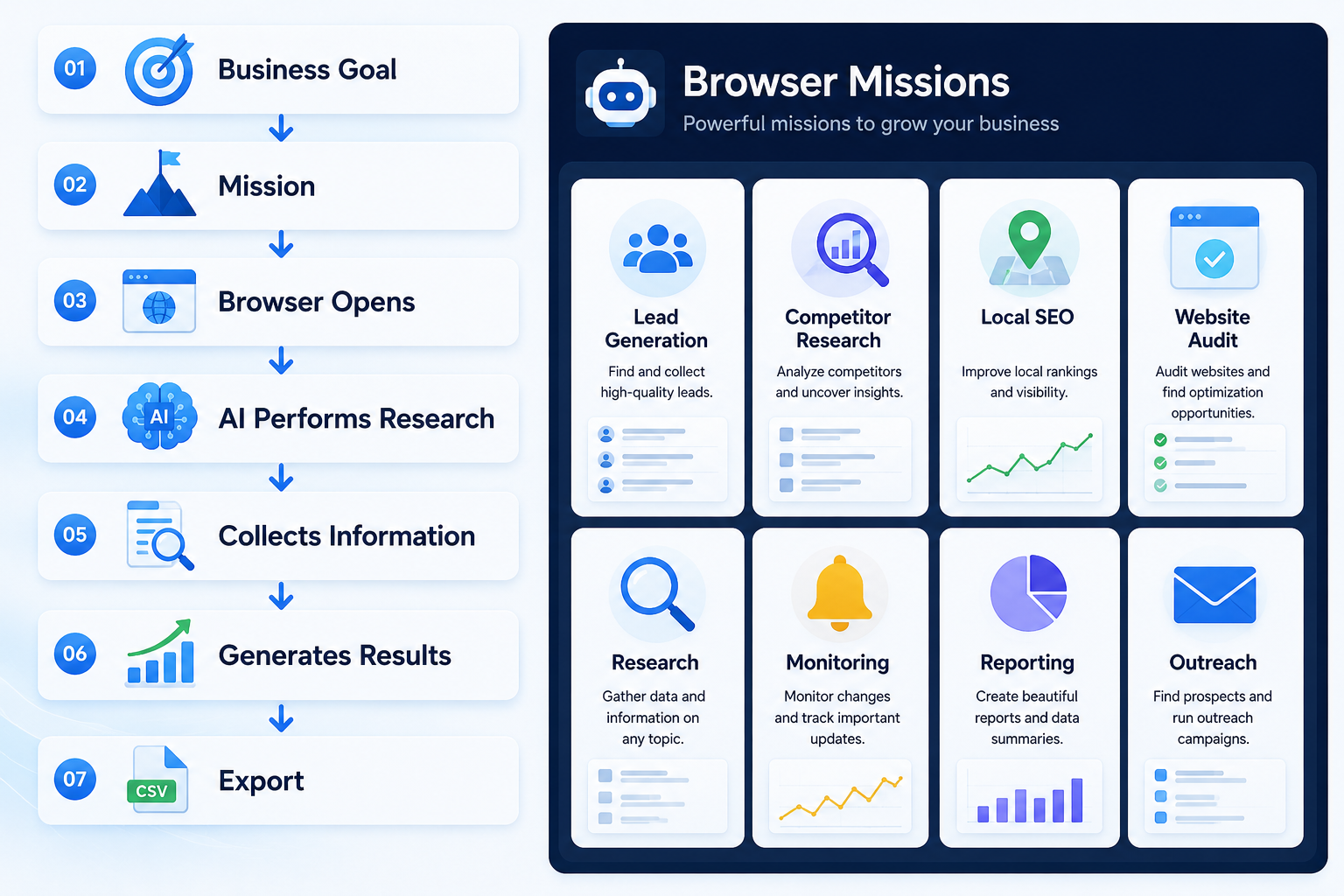
- Step 1: Define the business objective.
- Step 2: Choose or enter a BrowserAgent mission.
- Step 3: BrowserAgent starts a hosted browser session.
- Step 4: The AI performs browser actions related to the mission.
- Step 5: Information is collected, summarized, or organized.
- Step 6: The user reviews the output before using it.
The important point is that BrowserAgent should still be used with human review. Browser automation can reduce repetitive work, but it should not replace judgment, fact-checking, compliance review, or professional decision-making.
Watch The BrowserAgent Demo
This is the best place to watch the official demo because this section explains how BrowserAgent works.
BrowserAgent Core Features Explained
A feature list alone does not explain whether software is useful. The real question is how each feature supports practical business workflows. BrowserAgent’s strongest positioning is not simply that it uses AI, but that it applies AI to browser-based activities that many businesses repeat every day.
Below is a practical breakdown of the main BrowserAgent features and why they may matter for agencies, freelancers, consultants, researchers, marketers, and business owners.
AI Browser Missions
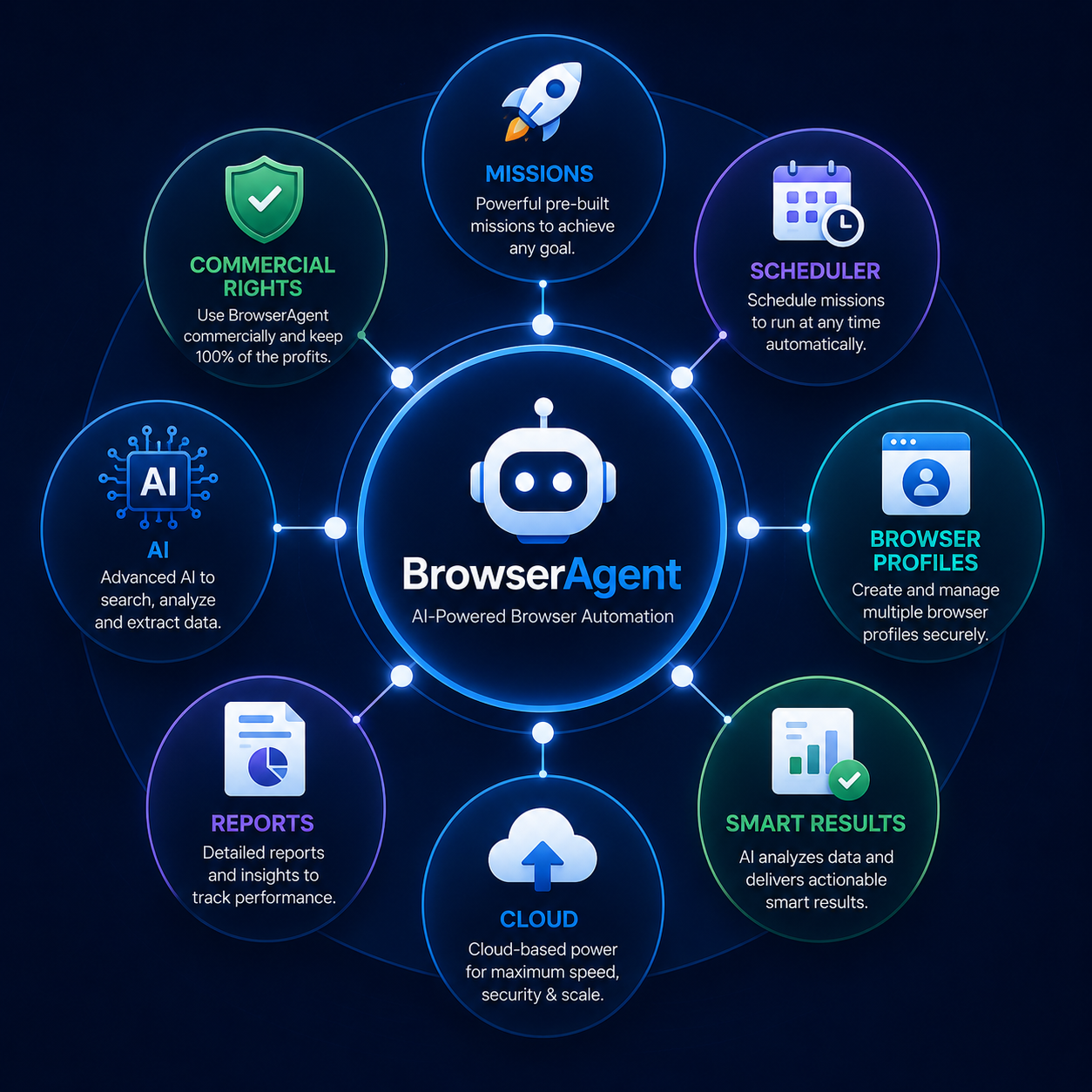
Missions are structured browser workflows. Instead of manually scripting automation, users can start from a mission designed around a business task such as research, monitoring, lead discovery, or reporting.
Live Browser Execution
BrowserAgent is designed to show browser activity while work is being performed. This makes the automation process easier to understand because users can see the browser workflow instead of receiving only a final answer.
Hosted Browser Environment
Rather than requiring complex local setup, BrowserAgent is positioned around hosted browser execution. This can reduce the technical barrier for users who want browser automation without managing scripts or local browser tools.
RepeatEngine Scheduling
Recurring browser tasks are where automation often becomes most useful. Scheduling can help with repeated monitoring, recurring research, weekly checks, and periodic reports.
Browser Profile Manager
Browser profiles are useful when repeatable browser environments are needed. This can help reduce repeated setup for workflows that are used again and again.
Smart Results
Browser activity only becomes useful when the output is organized. Smart Results are intended to help turn completed workflows into structured information that can be reviewed or used elsewhere.
Export Options
Export options such as CSV, Excel, and Google Sheets can make browser research easier to use in reports, dashboards, client deliverables, and follow-up workflows.
Commercial Rights
According to the launch details, commercial rights are included with the front-end offer under the official licensing terms. Buyers should always review the official license for exact usage conditions.
Mission Library
The mission library gives users starting points for common workflows such as lead generation, research, local SEO, competitor monitoring, reporting, and business automation.
BrowserAgent Missions Explained
One of BrowserAgent’s most important concepts is the mission library. A mission is a browser workflow designed to help complete a specific type of task. This makes BrowserAgent easier to understand because users can think in terms of outcomes rather than technical automation steps.
Instead of asking, “What feature should I use?” a better question is, “What browser task do I want completed?” That shift is important because it keeps the focus on business outcomes.
Common Mission Categories
| Mission Category | What It Helps With | Best For |
|---|---|---|
| Research Missions | Collecting and organizing public web information | Researchers, consultants, agencies |
| Lead Generation Missions | Finding and organizing potential prospects | Freelancers, sales teams, agencies |
| Local SEO Missions | Reviewing business listings, reviews, citations, and competitors | Local marketers and SEO professionals |
| Competitor Intelligence Missions | Monitoring websites, offers, messaging, reviews, and positioning | Agencies, consultants, business owners |
| Reporting Missions | Turning browser research into organized summaries or reports | Consultants, agencies, analysts |
| Monitoring Missions | Checking websites, competitors, public updates, or review sources repeatedly | Marketing teams, operations teams, business owners |
How To Choose Your First Mission
New users should avoid trying to automate everything immediately. The best starting point is usually the browser task you already repeat most often.
- If you do local SEO work, start with a local business audit or competitor review mission.
- If you are an affiliate marketer, start with product research or comparison research.
- If you are a consultant, start with market research or competitor intelligence.
- If you run an agency, start with a repeatable client report workflow.
- If you are a freelancer, start with lead discovery or prospect research.
The goal is not to run the most complex mission first. The goal is to identify one repeatable task, improve it, and then expand from there.
Real-World BrowserAgent Use Cases
Features explain what the software can do. Use cases explain why someone would use it. BrowserAgent is best understood as a workflow tool for people who repeatedly work inside web browsers.
The strongest potential use cases involve browser-heavy activities such as research, monitoring, reporting, lead discovery, competitor intelligence, and local SEO analysis.
Digital Marketing Agencies
Agencies often repeat similar workflows for multiple clients: audits, research, competitor reviews, listing checks, reports, and monitoring. BrowserAgent may help standardize those recurring processes.
Freelancers
Freelancers often handle client research, lead discovery, proposal preparation, and reporting themselves. Browser automation may help reduce repetitive manual research.
Affiliate Marketers
Affiliate marketers spend time researching products, studying sales pages, reviewing competitors, and preparing content. BrowserAgent may assist with the research stage.
Local SEO Professionals
Local SEO involves reviewing business listings, competitors, reviews, citations, and websites. These are browser-based workflows that often repeat across clients.
Business Consultants
Consultants frequently begin engagements with research. BrowserAgent may help gather public information before the consultant adds analysis, strategy, and recommendations.
Business Owners
Business owners can use browser workflows to monitor competitors, research suppliers, review customer feedback, and stay aware of market changes.
The Common Pattern Across Use Cases
Across industries, the pattern is similar:
BrowserAgent is designed to assist with the browser workflow portion of this process. It does not replace expert interpretation, but it may reduce the repetitive work required before analysis begins.
BrowserAgent By Industry
BrowserAgent is not limited to one niche. Its usefulness depends less on the industry and more on whether the work involves repeatable browser tasks.
| Industry / Role | Potential BrowserAgent Application |
|---|---|
| Marketing Agencies | Client audits, competitor research, monitoring, and monthly reports |
| Local SEO | Business listings, reviews, competitor checks, citation research |
| Consulting | Business research, competitor intelligence, market summaries |
| Ecommerce | Competitor monitoring, product research, review analysis |
| Real Estate | Area research, property research, local market comparisons |
| Recruiting | Company research, public profile review, outreach preparation |
| Affiliate Marketing | Product research, comparison research, review preparation |
| Business Research | Public information gathering, industry monitoring, trend tracking |
The key question is not “Does BrowserAgent support my industry?” The better question is “Does my work involve repetitive browser-based information gathering or reporting?”
Who Should Buy BrowserAgent?
BrowserAgent appears best suited for users who perform meaningful browser work on a regular basis. If your daily work involves visiting websites, collecting information, monitoring competitors, or preparing reports, BrowserAgent is more relevant.
- Digital marketing agencies
- SEO consultants
- Affiliate marketers
- Freelancers
- Business consultants
- Market researchers
- Business owners
- Operations teams
Best Fit Signal
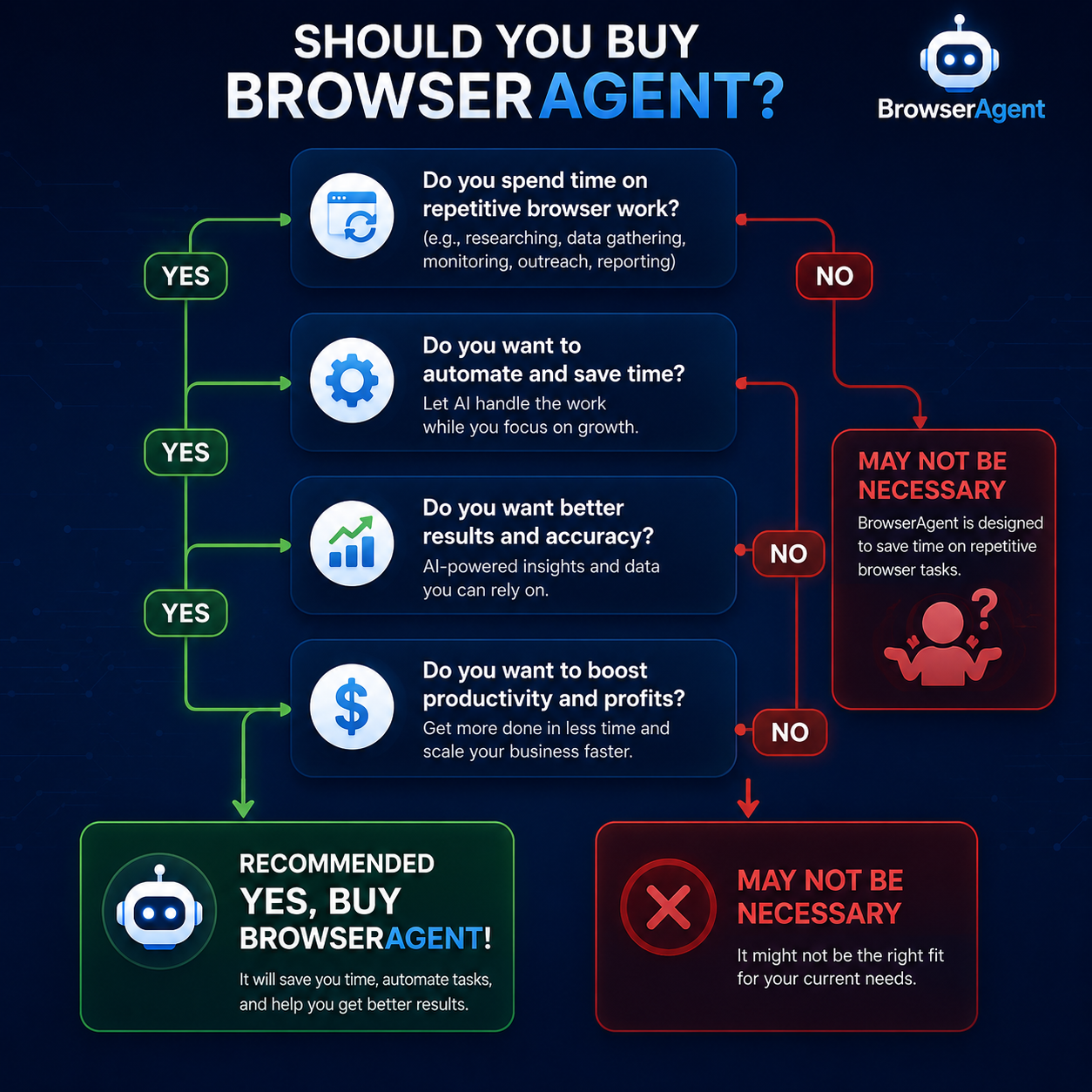
If you can name three browser tasks you repeat every week, BrowserAgent is worth evaluating. If you cannot name even one, it may not be necessary for you right now.
Who May Not Need BrowserAgent?
BrowserAgent is not the right choice for everyone. A trustworthy review should be clear about that.
You Only Want A Chatbot
If you mainly need brainstorming, writing, summarization, or conversation, a normal AI assistant may be enough.
You Rarely Use A Browser
If most of your work happens in desktop software or offline processes, browser automation may not provide much value.
You Expect Guaranteed Income
BrowserAgent is software. It does not guarantee clients, income, rankings, sales, or business results.
The best reason to buy BrowserAgent is not hype. The best reason is that you have real browser workflows that you want to complete more consistently.
BrowserAgent Pricing, Bundles & OTOs
Pricing is one of the most important parts of any software review because buyers want to understand what they are paying for before they click through. BrowserAgent is offered through a front-end product, bundle options, and several optional upgrades.
The pricing below is based on the official launch information provided for this campaign. Launch pricing, coupons, availability, and funnel structure may change after the launch period, so always confirm the current price on the official checkout page before purchasing.
Official BrowserAgent Pricing Table
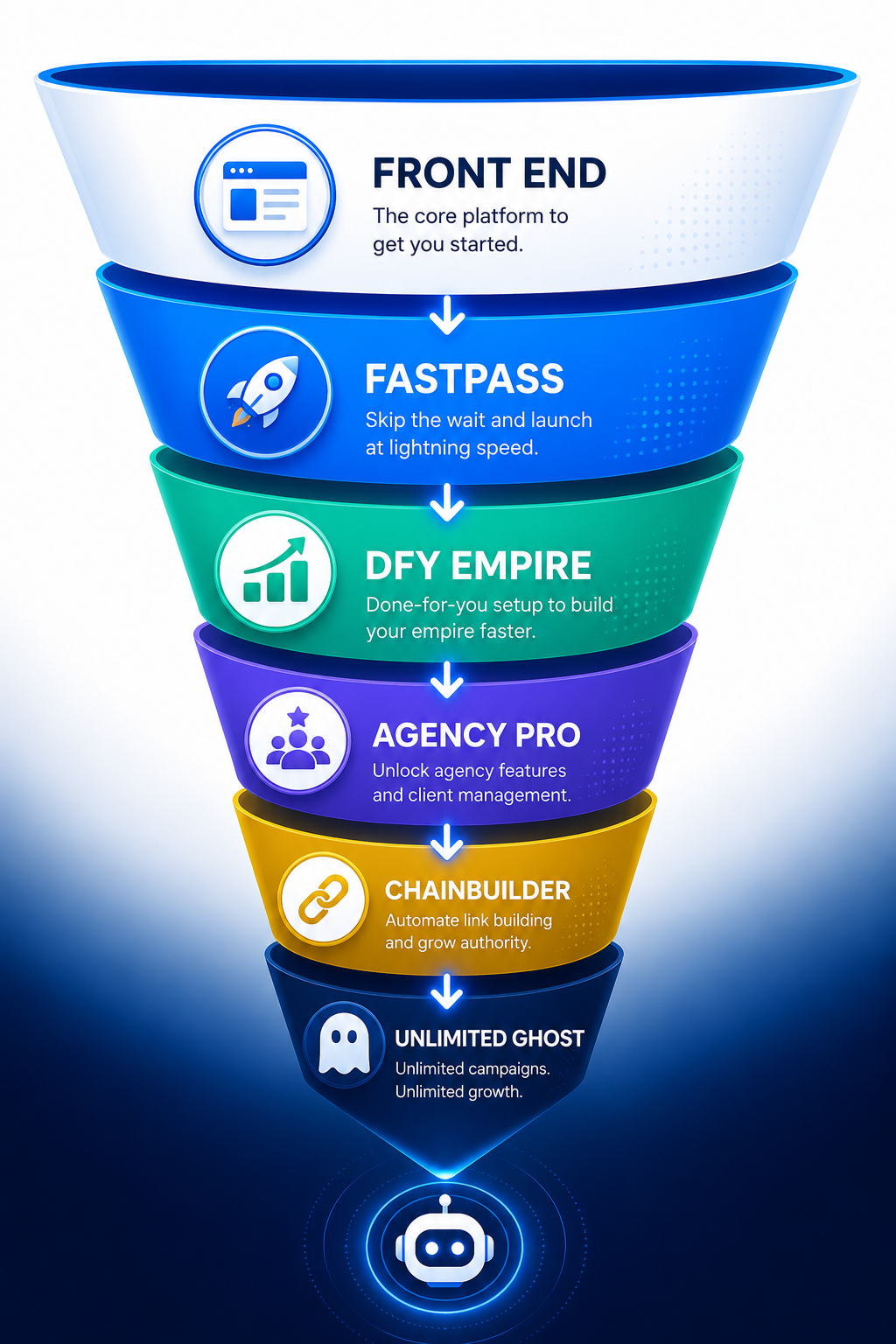
| Product | Price | Billing | Best For |
|---|---|---|---|
| FE: BrowserAgent | $37 | One-time | Core access, beginners, evaluation |
| xBundle with BROWSE coupon | $267 | Annual recurring | Buyers wanting the broader ecosystem |
| MegaBundle Order Bump | $77 | One-time | Additional bundle resources |
| FastPass | $230 | Annual recurring | Shortcut to multiple upgrades |
| OTO1: DFY Empire | $197 | One-time | Done-for-you missions, scripts, proposals |
| OTO2: Agency Pro | $97 | One-time | Agencies and client service delivery |
| OTO3: ChainBuilder Pro | $67 | One-time | Workflow chaining and automation |
| OTO4: Unlimited Ghost | $147 | One-time | Power users and higher-volume execution |
Front-End, xBundle, Mega Bundle & FastPass Explained
Many buyers get confused when they see a front-end product, order bump, bundle option, and multiple OTOs. The best way to think about the funnel is simple: start with what you actually need, then only add upgrades if they match your expected usage.
FE: BrowserAgent
The front-end is the core product and the logical starting point for most first-time users. It lets you evaluate BrowserAgent without committing to the larger ecosystem immediately.
xBundle
The xBundle is more relevant for buyers who want broader access and are comfortable with annual billing. With the BROWSE coupon, the launch price is listed at $267/year.
Mega Bundle
The Mega Bundle is positioned for buyers who want a broader package instead of only the front-end. This may be more attractive for users planning to apply BrowserAgent seriously.
FastPass
FastPass is an in-funnel shortcut designed for buyers who want access to multiple upgrades without evaluating every offer individually.
Best Beginner Path
For most beginners, the front-end is the lowest-risk starting point. Learn the platform first, then decide whether advanced upgrades are necessary.
Best Power User Path
For agencies or serious users, the Mega Bundle or xBundle may make more sense if BrowserAgent will become part of regular business operations.
BrowserAgent OTO Breakdown
BrowserAgent includes several optional upgrades. These are not required for every buyer. The best upgrade depends on how you plan to use the software.
OTO1: DFY Empire
Price: $197 one-time
DFY Empire is aimed at buyers who want done-for-you resources such as missions, scripts, and proposal-style assets instead of building everything from scratch.
OTO2: Agency Pro
Price: $97 one-time
Agency Pro is most relevant for agencies, consultants, and freelancers who plan to use BrowserAgent-supported workflows with client services.
OTO3: ChainBuilder Pro
Price: $67 one-time
ChainBuilder Pro is focused on connecting workflows and creating longer automation sequences rather than running isolated missions.
OTO4: Unlimited Ghost
Price: $147 one-time
Unlimited Ghost is positioned for higher-volume users who need expanded execution capacity or more advanced usage.
Who Needs OTOs?
Users who plan to use BrowserAgent regularly for business, agency, or client workflows may benefit more from upgrades than casual users.
Who Can Skip OTOs?
Users who are just evaluating the software can begin with the front-end and only upgrade if they later see a clear use case.
BrowserAgent Pros & Practical Considerations
A trustworthy review should explain both what looks strong and what buyers should consider before purchasing. BrowserAgent has a clear use case, but it is not a perfect fit for every user.
What BrowserAgent Appears To Do Well
- Focuses on browser-based workflows rather than generic AI chat.
- Uses missions to make automation easier to understand.
- Supports recurring workflows through scheduling concepts.
- Includes commercial rights on the front-end offer under the official terms.
- Appears especially relevant for agencies, consultants, marketers, and researchers.
- Helps users think in terms of repeatable browser processes.
What Buyers Should Consider
- BrowserAgent still requires human review and judgment.
- It is most useful when tasks are repeatable.
- There may be a learning curve while users understand missions.
- It does not guarantee income or business results.
- Users need to follow applicable website terms, policies, and ethical automation standards.
- Some buyers may only need the front-end, not the full funnel.
BrowserAgent vs Other AI Tools
BrowserAgent should not be compared only to normal AI chatbots because it is designed for a different type of work. Chatbots are useful for writing, planning, summarizing, and brainstorming. BrowserAgent is positioned around browser workflow execution.
| Tool Type | Primary Use | How BrowserAgent Differs |
|---|---|---|
| Traditional AI Chatbots | Writing, brainstorming, summarizing, answering questions | BrowserAgent focuses on browser workflows and task execution. |
| Manual Browser Research | Human-led searching, clicking, collecting, and organizing | BrowserAgent is designed to assist with repeatable browser tasks. |
| Traditional Browser Automation | Scripted automation, selectors, technical setup | BrowserAgent uses mission-based workflow concepts instead of code-first automation. |
| Workflow Integration Tools | Connecting apps and services together | BrowserAgent focuses on browser-based work rather than only app-to-app integrations. |
The right tool depends on the bottleneck. If your biggest bottleneck is writing, a chatbot may be enough. If your biggest bottleneck is repetitive browser work, BrowserAgent becomes more relevant.
BrowserAgent Best Practices
Buying software is only the first step. The real value comes from using it properly. BrowserAgent will be more useful when it is applied to clear, repeatable, reviewable workflows.
Start With One Workflow
Choose one browser task you repeat often. Master that before trying to automate everything.
Write Clear Objectives
Browser automation works better when the mission goal is specific and practical.
Review Every Output
Always verify important information before using results in client work, published content, or business decisions.
Document Successful Missions
When a mission works well, save the inputs, process, and output format so it can be repeated.
Use Scheduling Carefully
Recurring workflows can be powerful, but they should still be monitored and reviewed.
Keep Client Work Human
Use BrowserAgent for research and organization, then add your own analysis and recommendations.
Exclusive BrowserAgent Bonus Package
When you purchase BrowserAgent through my referral link, you receive my exclusive implementation-focused bonus package. These bonuses are designed to help you understand BrowserAgent faster, build useful AI browser workflows, package services, and apply automation in practical business situations.
This is not a random collection of unrelated bonuses. Each bonus is built to support BrowserAgent users with strategy, workflows, templates, agency systems, competitor research, and business automation guidance.

🎁 Bonus #1
BrowserAgent Quick Start Success Blueprint
Value: $97
A beginner-friendly guide to help new users understand BrowserAgent, plan their first workflows, avoid confusion, and get productive faster.
🎁 Bonus #2
250 Ready-to-Run Browser Missions
Value: $139
A practical mission library covering research, lead generation, local SEO, monitoring, reporting, competitor intelligence, and business workflow ideas.
🎁 Bonus #3
Your First $1,000 Using BrowserAgent
Value: $97
A practical strategy guide for turning BrowserAgent-supported workflows into realistic service ideas, client deliverables, and business applications.
🎁 Bonus #4
100 AI Business Ideas Powered by BrowserAgent
Value: $127
A curated idea bank showing different ways BrowserAgent-style automation can support services, research offers, agency workflows, and productivity systems.
🎁 Bonus #5
$10K AI Agency Blueprint
Value: $297
A complete agency-building guide covering service packaging, positioning, pricing, client acquisition, workflow delivery, and scaling principles.
🎁 Bonus #6
Complete AI Agency SOP Library
Value: $297
Ready-to-use SOP guidance for onboarding, research, delivery, reporting, quality control, operations, and repeatable AI-assisted agency workflows.
🎁 Bonus #7
Business Process Automation Guide
Value: $197
A workflow-focused guide to help users identify repetitive business tasks, map processes, and apply automation responsibly with human review.
🎁 Bonus #8
Competitor Intelligence Toolkit
Value: $147
Templates and frameworks for competitor research, market observation, offer comparison, positioning analysis, and client-ready intelligence reports.
📊 Regular Bonus Value
$1,398 Total
The eight core bonuses above are designed to help BrowserAgent buyers move from software access to practical implementation.
⭐ Preview One Premium Bonus Before You Buy
Want to see the quality before you decide? You can open a real sample bonus and review the formatting, depth, and practical style of the materials included in this bonus package.
This is only one sample. Qualifying buyers receive the complete bonus package after purchase verification.
With Limited Fast-Action Bonus: $2,395
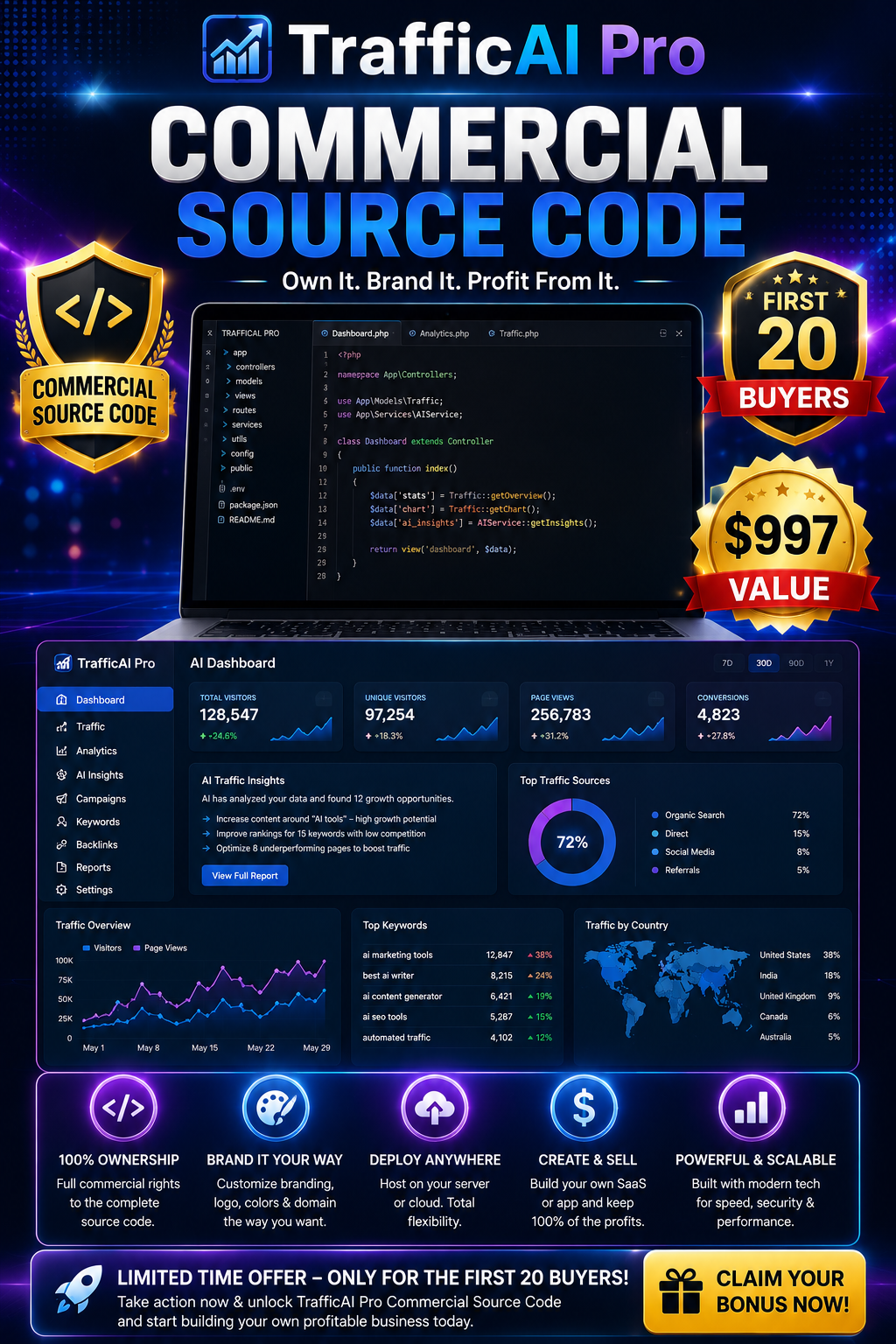
TrafficAI PRO Source Code
One of the most valuable bonuses available is the TrafficAI PRO Source Code package.
Rather than another PDF or checklist, this bonus is intended for buyers who enjoy learning from real software assets and understanding how AI-powered applications are structured.
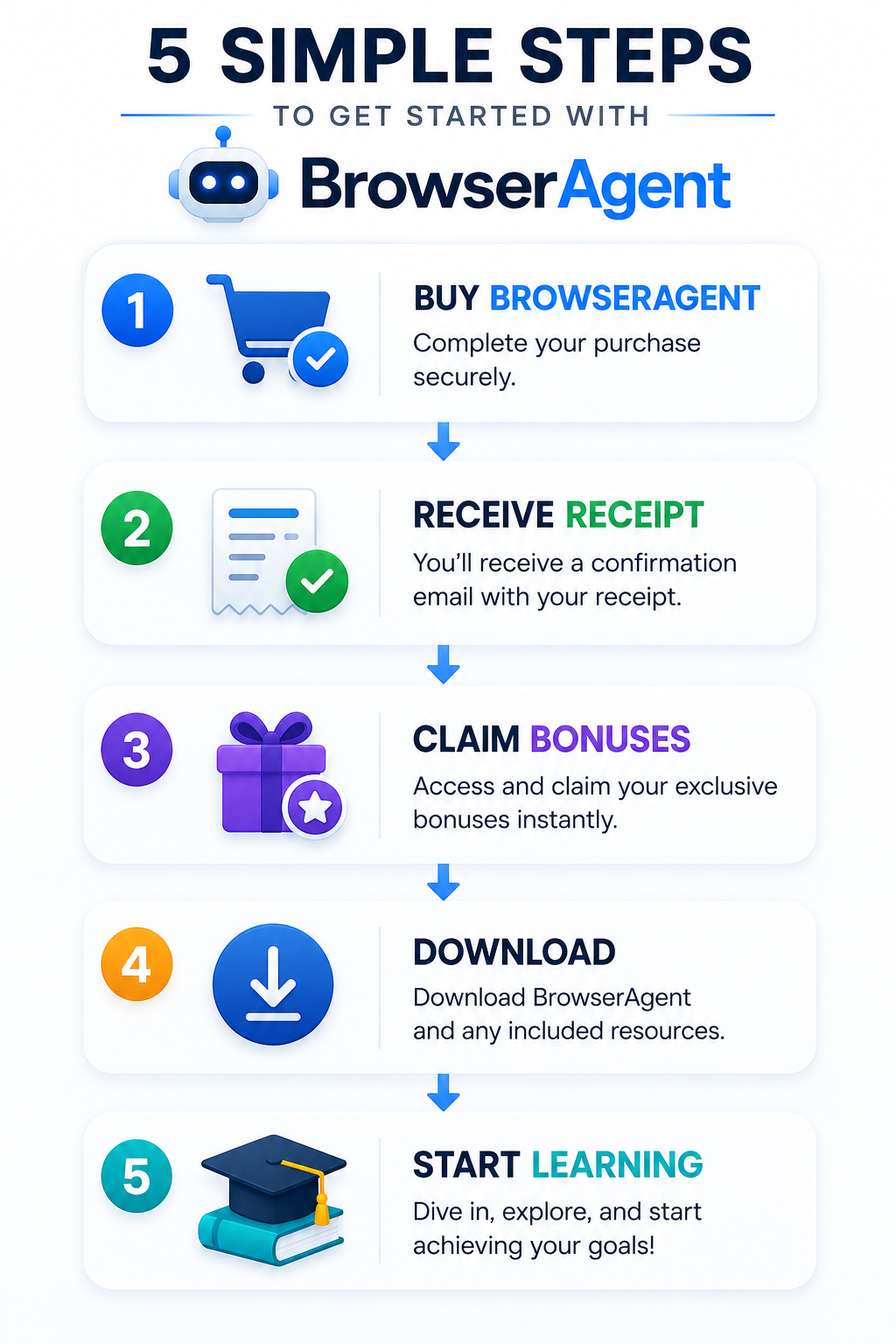
5 Simple Steps To Claim Your Bonuses
BrowserAgent FAQ
Is BrowserAgent beginner friendly?
Yes. The platform appears designed to make browser automation more approachable through mission-based workflows.
Does BrowserAgent guarantee income?
No. BrowserAgent is software. Business results depend on many factors including skills, effort, market conditions and implementation.
Are commercial rights included?
According to the official launch information, commercial rights are included with the front-end offer under the published license terms.
Can BrowserAgent replace employees?
No. BrowserAgent should be viewed as a productivity tool that assists browser workflows. Human review remains important.
Is BrowserAgent cloud based?
According to the launch information, BrowserAgent operates through a hosted browser environment.
AI Browser Automation Glossary
This glossary explains common terms used throughout this review and across the broader AI automation industry. These definitions are intentionally vendor-neutral and describe general concepts rather than BrowserAgent-specific marketing terminology.
1. AI Agent
An AI agent is a software system that can perform tasks on behalf of a user after receiving instructions or objectives. Unlike a traditional chatbot that simply answers questions, an AI agent is designed to execute actions, complete workflows, gather information, and sometimes make limited decisions within predefined boundaries. Modern AI agents are increasingly used for customer service, research, automation, scheduling, and business workflows where repetitive digital tasks can be completed more efficiently.
2. Browser Agent
A browser agent is an AI-powered system designed to interact with websites through a web browser. Rather than only generating text, it performs browser-based activities such as opening pages, navigating websites, collecting publicly available information, completing structured workflows, and organizing results. Browser agents are commonly used for research, monitoring, reporting, and repetitive browser tasks that would otherwise require manual effort.
3. Browser Automation
Browser automation refers to the use of software to perform actions inside a web browser without requiring every step to be completed manually. Common browser automation tasks include opening websites, filling forms, collecting information, monitoring pages, clicking interface elements, downloading files, and preparing reports. Businesses often use browser automation to improve consistency, reduce repetitive work, and increase productivity.
4. Workflow Automation
Workflow automation is the process of reducing manual effort by allowing software to perform repeatable business processes according to predefined rules or instructions. A workflow may include research, data collection, notifications, reporting, approvals, or document preparation. Effective workflow automation allows people to focus more on analysis, creativity, and decision-making while repetitive activities are handled automatically.
5. Mission
A mission is a predefined workflow that tells an automation system what objective should be completed. Rather than manually configuring every individual action, users select or define a mission describing the desired outcome. Missions may involve research, monitoring, lead discovery, reporting, website analysis, or other structured browser activities that follow repeatable steps.
6. Prompt
A prompt is the instruction provided to an AI system describing the task it should perform. Prompts may be short questions, detailed instructions, or structured workflows. Better prompts generally produce more accurate and useful results because they provide clearer objectives, context, and expected outputs for the AI to follow.
7. Natural Language Instruction
Natural language instructions allow users to communicate with software using everyday language instead of programming code. Rather than writing scripts or technical commands, users describe their objectives in plain English. Modern AI systems translate these instructions into actions that the software can perform automatically.
8. Cloud Execution
Cloud execution means software tasks are processed on remote servers rather than on a user's personal computer. This approach allows browser automation and AI workflows to run without requiring powerful local hardware. Cloud-based execution also makes it easier to access projects from multiple devices while reducing the need for local software installation.
9. Browser Profile
A browser profile stores settings, cookies, preferences, and browsing information used during browser sessions. Separate browser profiles help users keep different workflows organized and can simplify repeatable tasks by maintaining consistent browser environments across multiple automation sessions.
10. Scheduling
Scheduling allows software to perform tasks automatically at predetermined times or intervals. Rather than manually starting the same workflow every day or week, users configure schedules that launch browser activities on a recurring basis. Scheduling is commonly used for monitoring websites, generating reports, checking competitors, and recurring research.
11. Smart Results
Smart results refer to structured outputs generated after an AI or automation workflow completes. Instead of presenting raw browser activity, the software organizes collected information into summaries, reports, tables, or datasets that are easier for users to review, understand, and use in business decisions.
12. Commercial Rights
Commercial rights describe the permissions granted by a software license regarding business use. Depending on the license terms, commercial rights may allow buyers to use software while providing services to clients or generating revenue. Users should always review the official license agreement because commercial rights vary between software products.
13. Lead Generation
Lead generation is the process of identifying potential customers or business opportunities. Businesses often collect publicly available information such as company names, websites, contact details, industries, or locations before qualifying prospects for future sales activities. Automation tools can assist with organizing and researching publicly available lead information.
14. Competitor Intelligence
Competitor intelligence involves collecting publicly available information about competing businesses in order to better understand products, services, pricing, marketing strategies, customer feedback, and market positioning. Ethical competitor intelligence relies on publicly accessible information rather than confidential or proprietary data.
15. Research Automation
Research automation uses software to assist with gathering, organizing, and summarizing publicly available information from multiple online sources. Rather than replacing human analysis, research automation reduces repetitive browsing while allowing researchers, marketers, consultants, and business owners to spend more time interpreting the collected information.
AI Browser Automation Glossary (Terms 16–30)
16. API (Application Programming Interface)
An API is a standardized way for different software applications to communicate with one another. APIs allow systems to exchange data, trigger actions, or retrieve information without requiring direct human interaction. Many modern AI tools, automation platforms, CRMs, and reporting systems rely on APIs to integrate workflows efficiently.
17. CSV Export
CSV (Comma-Separated Values) is one of the most common file formats for exporting structured data. Browser automation tools often provide CSV exports so collected information can be opened in spreadsheet software, imported into databases, or shared with team members for additional analysis.
18. JSON
JSON (JavaScript Object Notation) is a lightweight format used for storing and exchanging structured data. APIs, AI platforms, and automation tools commonly use JSON because it is both human-readable and machine-readable, making it ideal for software integrations.
19. Data Extraction
Data extraction refers to collecting publicly available information from websites or digital sources and organizing it into a usable format. Businesses use data extraction for market research, competitive analysis, reporting, and operational workflows while respecting applicable website terms and legal requirements.
20. Browser Session
A browser session represents a single active browsing environment containing open pages, cookies, temporary storage, and user interactions. Maintaining separate browser sessions can help isolate workflows and improve consistency when performing repeatable browser tasks.
21. Task Queue
A task queue is an ordered list of jobs waiting to be processed. Automation platforms commonly use queues to manage multiple workflows, ensuring each task is completed in sequence without requiring continuous user supervision.
22. AI Workflow
An AI workflow combines one or more AI capabilities into a structured process that produces a desired outcome. Instead of relying on a single prompt, workflows organize multiple steps such as research, summarization, classification, reporting, and review into one repeatable system.
23. Human Review
Human review is the process of verifying AI-generated or automated output before it is published or used for business decisions. Responsible AI usage always includes human oversight, particularly when accuracy, compliance, or customer communication is involved.
24. Automation Rules
Automation rules define the conditions under which software performs specific actions. Rules may specify when workflows begin, what information should be collected, how results are organized, or when notifications are sent.
25. Local SEO
Local Search Engine Optimization focuses on improving the visibility of businesses within location-based search results. Local SEO often includes reviewing business listings, citations, customer reviews, competitor analysis, and local search performance.
26. Monitoring
Monitoring involves regularly checking websites, competitors, reviews, pricing, or other publicly available information for changes over time. Automated monitoring helps reduce repetitive manual checking while improving consistency.
27. Dashboard
A dashboard is a visual interface that displays key information, metrics, reports, or workflow results in one location. Dashboards help users quickly understand the status of ongoing projects and automation activities.
28. Reporting
Reporting is the process of presenting collected information in an organized format that supports analysis and decision-making. Reports may include summaries, tables, charts, recommendations, or supporting evidence gathered through research.
29. Data Validation
Data validation is the practice of reviewing collected information to identify errors, inconsistencies, duplicates, or outdated records. Validation helps improve reliability before information is used for business purposes.
30. Browser Intelligence
Browser intelligence refers to the structured collection and organization of publicly available web information for research, monitoring, competitive analysis, and business decision-making. Rather than replacing expertise, browser intelligence provides organized information that supports better human decisions.
AI Browser Automation Glossary (Terms 31–60)
31. Chromium
Chromium is the open-source browser project that powers many modern browsers. In browser automation, Chromium-based environments are often used because they support modern web standards and can be controlled programmatically. A hosted Chromium browser allows automation workflows to interact with websites in a browser-like environment.
32. Headless Browser
A headless browser is a browser that runs without a visible user interface. It can load pages, execute scripts, and perform browser actions in the background. Some automation systems use headless browsers for speed, while others show a visible browser so users can observe what is happening.
33. Visible Browser Automation
Visible browser automation lets users watch browser activity as it happens. This can be useful for transparency, training, quality control, and trust because users can see how a task is being completed instead of receiving only a final result.
34. Public Web Data
Public web data refers to information that is openly available on websites, directories, search results, public listings, public reviews, and similar sources. Even when information is public, users should still respect website terms, privacy expectations, and applicable laws.
35. Web Research
Web research is the process of collecting information from online sources to support decisions, reports, analysis, or content creation. AI browser tools can assist by reducing repetitive browsing, but human review is still important for accuracy and context.
36. Website Monitoring
Website monitoring involves checking a website repeatedly to detect updates, changes, new pages, pricing changes, content updates, or availability issues. Businesses use monitoring to track competitors, market activity, customer-facing pages, and operational information.
37. Competitive Analysis
Competitive analysis is the process of comparing your business, product, content, pricing, or marketing against competitors. It usually involves reviewing public information such as websites, offers, reviews, ads, positioning, and content strategy.
38. Local Business Audit
A local business audit reviews a business’s online presence across websites, listings, reviews, citations, and competitor results. Local marketers use audits to identify visibility gaps, reputation issues, listing inconsistencies, and improvement opportunities.
39. Citation Check
A citation check reviews business name, address, phone number, and listing consistency across local directories and online platforms. Citation consistency is important for local SEO because inconsistent information can confuse users and search engines.
40. Reputation Monitoring
Reputation monitoring involves regularly reviewing public reviews, ratings, comments, and customer feedback. Businesses use reputation monitoring to understand customer sentiment, respond to concerns, and identify recurring issues that may affect trust.
41. Client Deliverable
A client deliverable is a finished asset provided to a client, such as a report, audit, research summary, spreadsheet, recommendation document, or presentation. Automation can help gather information, but professional judgment is needed before delivery.
42. Service Packaging
Service packaging means turning a skill or workflow into a clearly defined offer. For example, a consultant might package competitor research, local SEO audits, or lead research into fixed-scope services with clear deliverables and pricing.
43. SOP
SOP stands for Standard Operating Procedure. It is a documented process that explains how to complete a task consistently. SOPs are useful for agencies, freelancers, and teams because they make repeatable work easier to train, delegate, review, and improve.
44. Quality Assurance
Quality assurance is the process of reviewing work before it is delivered or used. In AI automation workflows, quality assurance may include checking facts, verifying sources, reviewing formatting, removing errors, and ensuring the output matches the intended purpose.
45. Output Review
Output review means carefully checking the final result of an AI or automation workflow. This step is important because automated systems can miss context, misunderstand instructions, collect incomplete data, or produce results that require correction.
46. AI-Assisted Research
AI-assisted research uses artificial intelligence to support the research process. It may involve finding sources, summarizing information, organizing findings, or creating structured notes. The human researcher remains responsible for verifying accuracy and drawing conclusions.
47. Business Intelligence
Business intelligence refers to organized information that helps companies make better decisions. It may include competitor research, market trends, customer feedback, operational data, pricing changes, and performance reports.
48. Automation Ethics
Automation ethics refers to using automation responsibly. This includes respecting website terms, avoiding harmful behavior, protecting privacy, reviewing outputs, and making sure automation supports legitimate business processes rather than abuse or deception.
49. Rate Limits
Rate limits are restrictions on how often a website, API, or platform can be accessed within a certain period. Respecting rate limits helps prevent service disruption and is an important part of responsible automation usage.
50. Terms of Service
Terms of Service are the rules that govern how a website, platform, or software product may be used. Users should review relevant terms before automating browser activity, using commercial rights, or collecting information from online sources.
51. Data Privacy
Data privacy involves protecting personal information and handling data responsibly. AI and automation users should avoid collecting unnecessary personal data, follow applicable privacy laws, and use secure systems when handling sensitive information.
52. Export Workflow
An export workflow moves information from one system into another format, such as CSV, Excel, Google Sheets, or a report. Exports make collected data easier to review, analyze, share, or use in client deliverables.
53. Spreadsheet Output
Spreadsheet output refers to organized data that can be opened in tools such as Excel or Google Sheets. Spreadsheet-friendly formats are useful for lead lists, audit findings, competitor comparisons, monitoring logs, and structured research.
54. Workflow Mapping
Workflow mapping is the process of documenting each step in a task or business process. Before automating anything, it is useful to map the workflow so you understand what should happen, what inputs are needed, and what output is expected.
55. Task Automation
Task automation uses software to complete individual tasks with less manual effort. Examples include checking a website, collecting public information, exporting results, or generating a recurring report.
56. Process Automation
Process automation is broader than task automation. It connects multiple tasks into a larger workflow, such as research, validation, reporting, review, and delivery. Process automation is especially useful for agencies and teams.
57. AI Productivity Tool
An AI productivity tool helps users save time, organize work, generate outputs, or complete tasks more efficiently. The value of a productivity tool depends on whether it solves a real bottleneck in the user’s workflow.
58. Client Reporting
Client reporting involves presenting findings, progress, recommendations, or results to a client. Browser automation can help gather supporting information, but the final report should include human review, interpretation, and professional presentation.
59. Workflow Scalability
Workflow scalability refers to the ability to repeat a process across more clients, projects, locations, or tasks without increasing manual effort at the same rate. Standardized automation and SOPs can make workflows easier to scale.
60. AI Browser Workflow
An AI browser workflow is a structured process where AI assists with browser-based actions such as research, navigation, monitoring, information collection, and reporting. These workflows are most useful when they are repeatable, reviewable, and tied to a clear business objective.
BrowserAgent Resources
This section provides a convenient reference to the primary BrowserAgent resources discussed throughout this review. Some links are official vendor resources, while others relate to this review and its accompanying bonus package.
| Resource | Description |
|---|---|
| Official Sales Page | Visit the official BrowserAgent sales page to review current features, pricing, bonuses, and availability before purchasing. |
| Official Webinar Registration | Register for the official BrowserAgent live webinar to view demonstrations, launch announcements, and available promotions. |
| Official Product Demo | Embedded earlier in this review. Demonstrates BrowserAgent's browser-based workflow capabilities using the vendor's published demonstration video. |
| Product Support | Use the official BrowserAgent support desk for licensing questions, technical support, account access, and product-related assistance. |
| Knowledge Base | If available, consult the official documentation and tutorials for setup instructions, feature explanations, and troubleshooting guidance. |
| Privacy Policy | Review the official BrowserAgent privacy policy to understand how personal information is collected, stored, and processed. |
| Terms of Service | Review the software license, acceptable use policies, commercial rights, and other contractual terms before using the product commercially. |
| Refund Policy | Check the official refund policy for current eligibility requirements, refund periods, and applicable conditions. |
| Contact Information | Use the official vendor contact channels for account questions, business inquiries, or product assistance. |
| Your Bonus Claim Page | After purchasing through our referral link, visit the bonus claim page and submit your purchase details according to the instructions provided. |
| Your Bonus Support Email | If you experience any issues accessing your bonuses, contact our dedicated bonus support email listed on the bonus claim page. |
BrowserAgent Launch Information
This appendix summarizes the factual BrowserAgent launch information used in this review. Details may change after launch, so readers should always verify current pricing, availability, coupon terms, and product access on the official checkout page before purchasing.
| Product Name | BrowserAgent |
| Product Category | AI browser automation software |
| Launch Date | Tuesday, June 30, 2026 |
| Launch Time | 10:00 AM Eastern Time |
| Product Creator / Host | Abhi Dwivedi |
| Vendor / Company | VineaSX Solutions LLC |
| Platform / Retailer | JVZoo |
| Front-End Price | $37 one-time |
| Coupon Information | BROWSE coupon referenced for xBundle discount |
| xBundle Price | $267/year recurring with coupon BROWSE |
| Commercial Rights | Included on the front-end offer according to launch information, subject to official license terms |
Funnel Overview
| Offer | Price | Billing |
|---|---|---|
| FE: BrowserAgent | $37 | One-time |
| xBundle with BROWSE coupon | $267 | Annual recurring |
| MegaBundle Order Bump | $77 | One-time |
| FastPass | $230 | Annual recurring |
| OTO1: DFY Empire | $197 | One-time |
| OTO2: Agency Pro | $97 | One-time |
| OTO3: ChainBuilder Pro | $67 | One-time |
| OTO4: Unlimited Ghost | $147 | One-time |
Bonus Summary
The exclusive bonus package described in this review includes eight primary bonuses plus a limited fast-action bonus. The regular bonus package value is listed as $1,398. With the TrafficAI PRO Commercial Source Code fast-action bonus, the total stated bonus value is $2,395.
Version History
Initial Review Version: Prepared for the BrowserAgent 2026 launch period using official launch information, funnel details, demo information, and independent editorial analysis.
Practical BrowserAgent Workflow Ideas
This appendix provides practical workflow ideas for applying AI browser automation in business settings. These are educational examples, not income claims or guaranteed outcomes.
Weekly Competitor Monitoring
Goal: Track competitor website changes, offers, positioning, or content updates.
Human review: Confirm findings and decide whether changes require action.
Local SEO Audit
Goal: Review business listings, reviews, competitors, and website visibility signals.
Human review: Turn findings into client-ready recommendations.
Lead Research Workflow
Goal: Identify potential prospects and organize publicly available business information.
Human review: Validate prospects before outreach.
Affiliate Product Research
Goal: Review product pages, feature claims, pricing, bonuses, and competitor reviews.
Human review: Create original analysis and proper affiliate disclosures.
Ecommerce Competitor Check
Goal: Monitor publicly visible competitor product pages, messaging, pricing, or promotions.
Human review: Interpret findings before changing pricing or strategy.
Reputation Monitoring
Goal: Review public customer feedback, ratings, and review trends.
Human review: Decide how to respond and improve customer experience.
Market Research Summary
Goal: Collect publicly available information about trends, competitors, and industry activity.
Human review: Add expert interpretation and business context.
Client Reporting Workflow
Goal: Gather supporting information for monthly or weekly client reports.
Human review: Finalize insights, recommendations, and formatting.
Website Review Workflow
Goal: Review a website’s structure, messaging, calls to action, trust signals, and visible issues.
Human review: Provide strategic recommendations before delivery.
Editorial Methodology & Sources
This review was prepared as an evidence-based buyer’s guide rather than a hype-driven affiliate page. The goal is to help readers understand BrowserAgent, evaluate the pricing and funnel, review practical use cases, and decide whether the product matches their own workflow.
Information Sources Used
- Official BrowserAgent sales materials
- Official BrowserAgent JV and launch information
- Official demo video
- Official pricing and funnel details provided for the launch
- Official webinar information
- Bonus package details created for this campaign
- Independent editorial analysis
What This Review Does Not Do
- It does not claim personal testing where no testing was performed.
- It does not invent income results, screenshots, or testimonials.
- It does not guarantee that users will earn money, save a specific number of hours, or achieve specific business outcomes.
- It does not present editorial opinions as official product claims.
How Claims Are Handled
Product descriptions are based on official launch information and publicly provided materials. Analysis sections explain what those features may mean for different types of buyers. Where recommendations are given, they are editorial opinions based on documented product positioning, use cases, pricing, and practical workflow considerations.
Accuracy Notice
Pricing, coupons, bonuses, product access, license terms, and funnel structure may change after publication. Readers should always verify current information on the official sales page and checkout page before purchasing.
Affiliate Disclosure Reminder
This review contains affiliate links. If you purchase through those links, we may earn a commission at no additional cost to you. The presence of affiliate links does not change the editorial goal of helping readers make an informed buying decision.
BrowserAgent Review Final Verdict
BrowserAgent introduces a different way of thinking about AI. Rather than focusing only on generating content, it focuses on helping users complete browser-based workflows more efficiently.
For agencies, consultants, freelancers, researchers and marketers who spend significant time working inside web browsers, BrowserAgent appears to offer an interesting workflow-oriented approach.
As with any software purchase, buyers should evaluate whether the product matches their own workflow requirements rather than expecting automatic business results.
Original Publication: June 2026
Last Updated: June 2026
Review Type: Independent Editorial Review
Reading Time: Approximately 20–25 minutes
Intended Audience: Agencies, freelancers, consultants, marketers, researchers, and business owners evaluating BrowserAgent.
Important Disclaimers & Editorial Disclosure
Transparency and accuracy are important to us. The following disclosures explain how this review was prepared, how affiliate commissions work, and what readers should know before making a purchasing decision.
Editorial Independence
This BrowserAgent review was prepared as an independent editorial resource designed to help prospective buyers understand the product, its features, pricing, optional upgrades, bonuses, and potential business applications.
Our objective is to provide balanced, factual, and practical information that helps readers make informed purchasing decisions rather than relying solely on promotional materials.
Affiliate Disclosure
Some links throughout this review are affiliate links. If you choose to purchase BrowserAgent through one of these links, we may earn a commission at no additional cost to you.
These commissions help support the time required to research products, create detailed reviews, maintain this website, and provide the exclusive bonus package described on this page.
Receiving an affiliate commission does not influence our editorial approach. We aim to present both strengths and practical considerations so readers can make their own informed decisions.
Product Information & Accuracy
Product descriptions, pricing, bonuses, commercial rights, launch information, funnel details, and promotional offers referenced throughout this review are based on official BrowserAgent launch materials and publicly available information at the time this article was prepared.
Software products evolve over time. Features, pricing, bonuses, coupon codes, licensing terms, availability, and promotional offers may change without notice.
For the most current information, always verify details directly on the official BrowserAgent sales page before completing your purchase.
Review Methodology
This review combines official product documentation, launch materials, pricing information, vendor demonstrations, publicly available resources, and independent editorial analysis.
Unless specifically stated otherwise, this review should not be interpreted as a claim that every feature has been personally tested. Where opinions are expressed, they represent editorial analysis rather than official vendor statements.
Results Disclaimer
BrowserAgent is a software application intended to assist users with browser-based workflows, automation, productivity, research, and related business processes.
No software can guarantee income, business growth, client acquisition, search rankings, productivity improvements, or any other specific outcome.
Individual results depend on numerous factors including experience, implementation, market conditions, business model, effort, and the manner in which the software is used.
Responsible AI & Automation
Artificial intelligence and browser automation should always be used responsibly.
Users remain responsible for reviewing generated outputs, verifying important information, complying with applicable laws, respecting website Terms of Service, protecting personal information, and exercising professional judgment before relying on automated results.
Third-Party Websites & Trademarks
BrowserAgent may interact with publicly available information published on third-party websites.
All trademarks, service marks, logos, copyrights, and brand names mentioned throughout this review remain the property of their respective owners and are used solely for identification, commentary, comparison, or review purposes.
Pricing & Availability
Launch pricing, coupon codes, bonuses, bundle contents, OTOs, commercial rights, and promotional offers may change after publication.
Readers should always confirm current pricing and offer details on the official BrowserAgent website before making a purchasing decision.
Bonus Disclaimer
The exclusive bonus package described on this page is provided by us unless specifically identified as an official BrowserAgent bonus.
Bonuses are available only for qualifying purchases completed through our referral links and submitted according to the published bonus claim instructions.
Bonus availability, delivery methods, and included resources may be updated periodically to improve the overall value offered to purchasers.
Copyright Notice
This review is original editorial content protected by applicable copyright laws.
Unauthorized copying, republication, or redistribution of substantial portions of this review without permission is prohibited.
This review is provided for educational and informational purposes only. Nothing contained on this page should be interpreted as financial, legal, tax, accounting, or professional business advice.
Prospective buyers should evaluate BrowserAgent according to their own workflow requirements, review the official documentation, and determine whether the product is appropriate for their individual needs before purchasing.

Thank You For Reading
We hope this review has helped you better understand BrowserAgent, its features, pricing, optional upgrades and whether it fits your workflow.
Don’t Miss The BrowserAgent Launch Deal
BrowserAgent launches with the $37 front-end offer plus a bundle option. Use coupon code BROWSE for the bundle deal where available.
Purchase through our link to qualify for the exclusive bonus package valued up to $2,395.
No income guarantees. Pricing and coupon availability may change after launch.