KDPGlobal Review 2026: Features, Pricing, Upgrades, Discount & Bonuses

 Review · Pricing · Publishing workflow
KDPGlobal Review: One Book, More Markets?
The appeal is one book, prepared for more readers. Here’s what to check before you buy.
$17 listed front end · Optional upgrades · Supplied code KDG20OFF

Original vendor product artwork
Affiliate disclosure: We may earn a commission if you purchase through our links, at no additional cost to you. This is a research-based evaluation. Check companion bonus eligibility and delivery before ordering.
The short answer: a promising workflow that deserves a careful first project
KDPGlobal brings together a set of tasks that can make self-publishing feel fragmented: finding an idea, drafting the manuscript, creating a cover, preparing listing information, and adapting a book for other languages. The reason to investigate it is the possibility of moving between those stages with fewer separate tools and less repetitive preparation.
Our recommendation is conditional. It could suit a publisher who wants help producing material and is willing to review it. Before buying, establish what the $17 front end includes, inspect representative outputs, and clarify the publishing route. The strongest sales-page claims about effortless publication and income go beyond what we can independently verify.
This is a research-based review of the supplied sales page and funnel details, with relevant publishing requirements checked against official sources. We have not used a paid KDPGlobal account or independently tested its generated manuscripts, translations, credit allowances, or integrations. The product videos and illustrations are vendor materials. Our companion bonuses are separate resources prepared by ePlanetJReviews.com.
For a first project, the sensible objective is one useful, reviewed book. That gives you a concrete way to assess output quality, correction time, export usability, and actual costs before expanding into more languages or buying capacity upgrades. It is a much stronger basis for a decision than the number of titles a dashboard says you can create.
Watch the sales presentation
Vendor-supplied VSL. Assess its claims alongside the review and current terms. Watch on YouTube.
What is KDPGlobal?
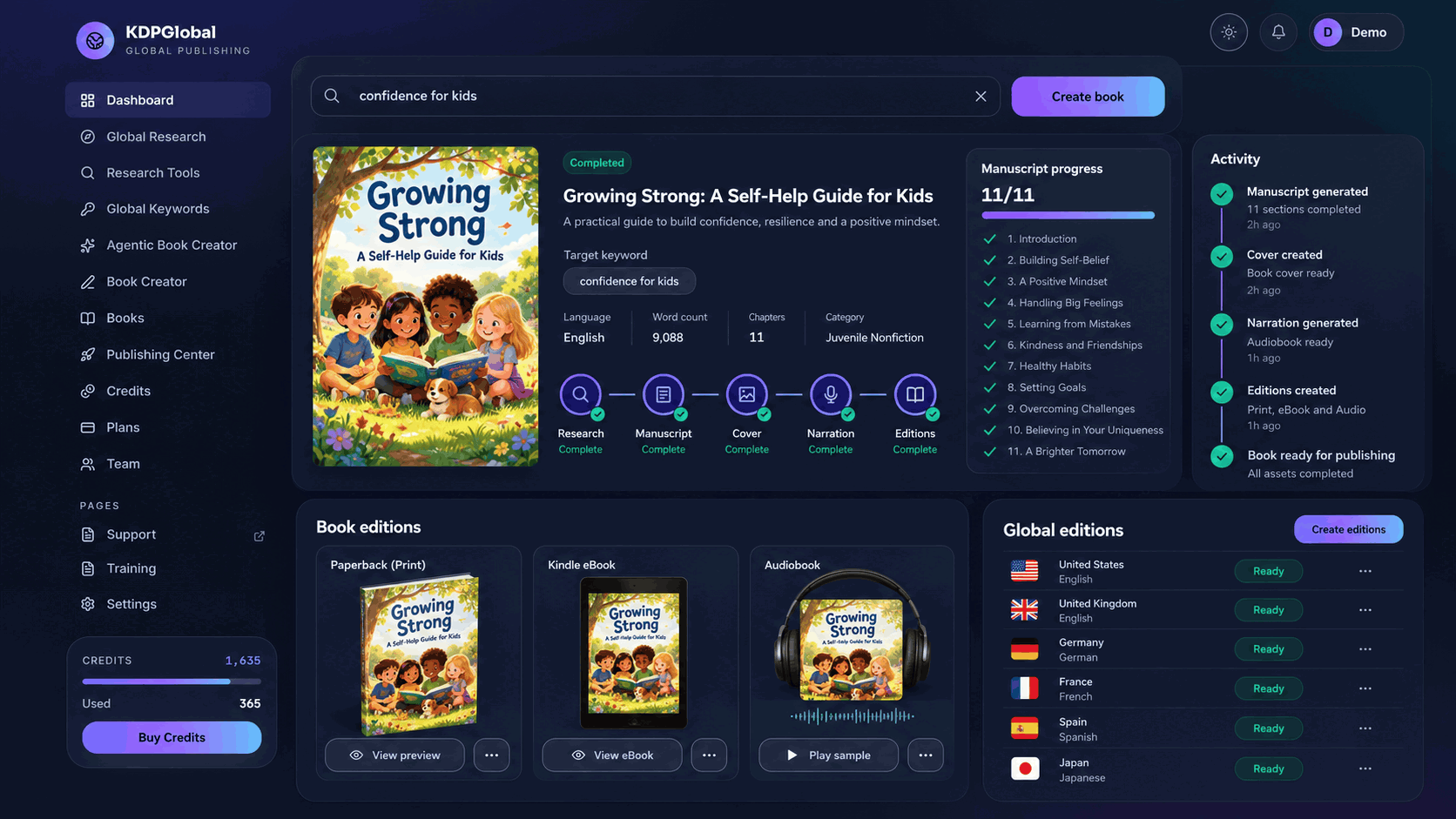
KDPGlobal is advertised as an AI-powered publishing platform that takes a book idea through research, manuscript generation, cover creation, formatting, localization, and listing preparation. The sales page also promotes narration and direct publishing. Those later capabilities need their own verification because a generated file, an authorized submission, and a live retail listing are different outcomes.
The multilingual element is the most interesting part of the offer. Once you have a good source book, preparing another edition usually involves more than translating paragraphs. You also need a suitable title, description, terminology, examples, and reader expectations. A coordinated workspace could reduce the administrative burden of managing those related assets.
The practical question is how much useful work the platform completes in the version you buy. A fluent manuscript still needs an editor's judgment. A cover needs readable text and appropriate imagery. A translated instruction needs to preserve its meaning. A publishing package needs to work in the intended format. These are the checks that turn software output into a product you can stand behind.
Consider an illustrative guide for people starting a balcony garden. A worthwhile book helps readers observe their conditions, select a manageable setup, and establish a care routine. A generic chapter about the benefits of gardening contributes little to that task. KDPGlobal's value would depend on whether it helps you prepare the specific material efficiently and whether correcting it requires a reasonable amount of work.
How the workflow should be evaluated
Begin with the reader brief. Specify who the book serves, what they want to do, what they already know, and what constraints matter. In the balcony example, limited space, climate, sunlight, and maintenance time change the recommendations. Give the software a specific assignment and assess its output against that assignment.
Next, inspect the outline and a complete chapter. Check whether the sequence makes sense, terms are explained, examples are useful, and claims are qualified. Look for repetition between chapters and contradictions in recurring examples. A book can sound polished while leaving the reader uncertain about the next action. That is a content problem worth fixing before formatting.
Then examine the cover and exported files. Open the actual ebook or print output, follow navigation links, and inspect tables, captions, illustrations, and page boundaries. Keep an editable source and a clean release copy. A vendor dashboard image helps explain the product's positioning, but your own export is the file that determines the reader experience.
After reviewing the source book, test one localized edition. Choose a language you can have competently checked, prepare a small glossary, and review a representative sample before translating everything. Translation quality is hard to judge from appearance when you do not understand the language. Qualified review is therefore a real production dependency.
Finally, ask the vendor to demonstrate the publishing stage precisely. What gets prepared? What gets submitted? Which account authorization is required? Which action remains yours? This distinction lets you evaluate the workflow honestly, including any manual steps, rather than relying on the broad promise of one-click publication.
See the operational demo
The same supplied video serves as teaser and demo, so it is embedded once here. Watch on YouTube.
Features that could make a practical difference
The niche research component could help organize ideas and identify questions worth investigating. Its usefulness depends on the underlying evidence. Ask whether an opportunity score represents current marketplace observations, a modeled estimate, or an AI suggestion. Record what the number measures before allowing it to drive a publishing investment.
Manuscript generation matters when it creates a usable structure and material that can be improved efficiently. In nonfiction, assess whether each chapter helps the reader understand something necessary or complete a useful task. Check factual support, continuity, missing prerequisites, and examples. Length alone tells you little about whether a book delivers its promise.
Cover creation and formatting may reduce handoffs, especially for a small publisher. The test is the quality of the actual files. Look for spelling defects in images, poor thumbnail readability, inconsistent titles, and formatting that breaks after export. Print specifications also depend on the intended configuration and final manuscript. A product mockup cannot establish those details.
Localization and metadata preparation could save repetitive work across editions. The strongest test is a competent review of meaning, terminology, cultural references, and listing language. Country-specific search phrases require more thought than literal keyword translation. A natural title and accurate description should help the intended reader understand the book's relevance.
The advertised catalog management function may help keep editions organized. That becomes useful when a source correction affects several translations or when listing material changes. Before relying on it, ask what data is tracked automatically, what must be entered manually, and what can be exported. Keeping your files outside one platform makes the workflow easier to maintain.
The page also promotes narration, originality protection, agency use, and automation. Evaluate each on its own terms. A plagiarism check cannot establish every rights question. Agency permission needs readable license terms. Audio needs an eligible distribution route. Automated actions need a demonstration and clear account permissions. Ask for the evidence that matches the feature you actually intend to use.
Pricing, the coupon, and the nine optional upgrades
The supplied funnel lists KDPGlobal's front end at $17. It then lists nine optional upgrades with two quoted prices each. We preserve both figures below because the lower amount should not be assumed to be available to every visitor. The selected edition, checkout presentation, scope, and terms need confirmation at the point of purchase.
The supplied discount code is KDG20OFF, described as 20% off. Copy the code and check whether the selected item accepts it. We have not completed a transaction to verify its scope or stacking rules. If accepted on a $17 item, the arithmetic would be $13.60 before any applicable charges. The actual checkout total is the figure to rely on.
Before budgeting, obtain the front-end entitlement breakdown: included credits, book allowances, translation limits, replenishment rules, export access, and any external service costs. The sales page's unlimited language needs to be reconciled with the separately priced Unlimited upgrade. A one-time entry price does not answer the capacity question by itself.
Avoid treating the funnel as a shopping list. More capacity matters only after you are satisfied with output quality. A done-for-you service needs a written delivery scope. Automation needs a specific account workflow. A traffic or website product needs its own assessment. Buying several products together does not make their promises easier to verify.
| Stage | Edition | Quoted price | Alternate quote |
|---|---|---|---|
| Front end | KDPGlobal | $17 | — |
| OTO 1 | Unlimited | $67 | $47 |
| OTO 2 | Done For You | $297 | $197 |
| OTO 3 | Automation | $47 | $27 |
| OTO 4 | Income Maximizer | $47 | $27 |
| OTO 5 | Limitless Traffic | $97 | $77 |
| OTO 6 | DFY Money Site | $67 | $47 |
| OTO 7 | AI Income Site | $47 | $27 |
| OTO 8 | Reseller | $197 | $97 |
| OTO 9 | AI Traffic Machine | $47 | $27 |
Alternate prices and coupon eligibility are not guaranteed. Exact upgrade entitlements need checkout/vendor confirmation.
Code: KDG20OFF
Check acceptance and the final total at checkout.
Which upgrades deserve a closer look?
Unlimited is the first capacity question. Its supplied prices are $67 and $47. Ask what the front end already permits and precisely which limit changes with this purchase. If a small pilot fits the entry allowance, testing that first may be enough to inform the next decision. If a necessary workflow requires extra capacity, establish that cost before buying.
Done For You is quoted at $297 and $197. Ask what is delivered, who performs the work, what you must provide, how revisions work, and what happens if the output is unsuitable. The label does not establish whether the service includes books, configuration, coaching, or something else. A clear scope is particularly important at this price.
Automation is quoted at $47 and $27. Income Maximizer has the same quoted prices. For each, request the specific difference from the front end. Determine whether it is software functionality, a workflow, training, or a service. Until that is clear, there is no reliable basis for saying it is essential or will increase earnings.
Limitless Traffic, DFY Money Site, AI Income Site, Reseller, and AI Traffic Machine introduce different business questions. Traffic needs source and measurement details. Websites need hosting and maintenance terms. Reseller access needs clear rights, fulfillment, restrictions, and support responsibilities. Evaluate these independently of whether you like the book creation interface.
For a simple budget comparison, the front end plus the first quoted Unlimited price totals $84 before any eligible discount or other charges. Using its alternate quoted price would total $64. Those figures show the size of one possible combination; they are neither verified checkout offers nor a recommendation to buy it. Match spending to a demonstrated requirement.
The publishing responsibilities that remain yours
The most important limitation is the distance between generating content and publishing a good book. The sales copy repeatedly emphasizes almost no effort. A credible production plan still needs editorial review, file inspection, rights checks, and an accurate reader promise. Those tasks should be visible in your budget and schedule.
Amazon requires disclosure of AI-generated text, images, and translations, including generated material that receives substantial editing. It also places responsibility for compliant content on the publisher. Keep a record of how your material was created so you can answer publication questions accurately. The current definitions are linked in the source section.
Audiobooks need a separate eligibility check. ACX's published requirements call for human narration unless otherwise authorized and prohibit unauthorized automated recordings. An AI audio export therefore does not by itself establish an eligible Audible release. Ask which authorized distribution route applies to your content and account before making narration central to your purchase.
The guarantee also needs a clear answer. The supplied page presents broad 30-day refund language, while its guarantee terms describe conditions involving evidence of work and requests for help. Read the terms attached to your selected transaction and ask the vendor to reconcile the difference. We would not describe the guarantee as unconditional on that evidence.
Finally, distinguish software access costs from book production costs. Editing, qualified translation review, design work, and other services may still be necessary. Server-dependent features also rely on continued vendor operation. Understand export and retention terms, keep backups of important work, and base a project budget on the complete task rather than the entry fee alone.
Who is likely to get value from this approach?
The strongest fit is a publisher who wants to reduce repetitive preparation while retaining control over quality. If you can define a reader task, evaluate a draft, obtain suitable review, and inspect files, a connected workspace may simplify production. Existing publishers with a useful source book may have a clearer localization opportunity than someone still looking for a first idea.
A beginner could investigate it through a controlled pilot. Choose one narrow subject within your competence, preserve room in the budget for review, and set a concrete completion standard. One useful book teaches more about the workflow than a large collection of unreviewed drafts. The entry price should make an experiment manageable, rather than encourage an immediate expansion into every upgrade.
It is a poor fit for buyers expecting guaranteed royalties, automatic rankings, or a publishing business requiring no judgment. It is also unsuitable when the intended subject needs expertise you cannot obtain or when you plan editions in languages nobody on the project can evaluate. Software convenience does not resolve those dependencies.
If you remain unsure, request a complete sample output, a front-end limit table, and a current explanation of the publication and audio routes. Compare those with your intended project. You do not need every advertised capability to be useful, but you do need the capabilities influencing your purchase to be available and demonstrable.
Compare the complete task with your existing workflow
A practical alternative is a modular process: reader research, a writing and editing tool, design, formatting, and publication managed separately. KDPGlobal's potential advantage is fewer handoffs. A modular process makes it easier to inspect or replace one component without depending on a single platform for every stage. Your current friction should determine which arrangement is more useful.
Use the same brief to compare outputs. Assess the quality of a representative chapter, correction time, usability of exports, and total cost of completing a reviewed edition. Include human effort on both sides. Comparing a polished vendor illustration with your own rough first attempt would tell you little about the production task.
For international editions, compare review effort as carefully as generation speed. Check terminology, local examples, and whether corrections introduce inconsistencies elsewhere. A strong first translation can save time while still needing an editor. A quick draft requiring extensive repair may produce little real saving. Measure the route to a usable edition.
If your current tools already work well and you publish occasionally, switching may offer limited benefit. If you repeatedly prepare related assets across several editions, integration may deserve a pilot. Keep the experiment tied to a specific bottleneck so you can tell whether the platform improves your work.
Seven companion bonuses for the implementation work
The ePlanetJReviews.com collection supports the work around manuscript generation. It contains four offline browser tools, three written guides exceeding 6,000 substantive words each, and 21 editable worksheets. The tools do not unlock vendor features or include hosting, AI credits, automatic publication, or live Amazon sales connections.
Each resource has a proposed standalone price, with a combined target of $1,079. These figures are pricing estimates for the prepared deliverables, not established retail prices or evidence of earlier sales. Confirm qualifying purchase tiers and access instructions with Team ePlanetJReviews.com before ordering if bonus access influences your decision.
AI Manuscript Quality Studio
Use this browser tool to inspect one chapter, record editorial ratings, track evidence in notes, and save revisions. It flags exact repeated paragraphs, long sentences, and possible factual or absolute claims using transparent rules. Those findings help prioritize a human review; they do not verify facts or certify originality.
For the balcony guide, you could flag an unsupported harvest guarantee, record the correction, and compare the revised paragraph with the saved draft. Reports and JSON backups can be downloaded. The immediate benefit is a repeatable review workspace that makes unresolved issues visible before formatting or localization begins.
Global Publishing Localization System
This written guide takes you through defining an edition, locking the source, preparing a glossary, reviewing a sample, commissioning human review, inspecting exports, and managing later changes. Seven editable worksheets accompany the instruction, including an edition brief, adaptation register, issue log, and release record.
Use it when a reviewed source book is ready for one additional language. For the gardening example, record climate assumptions, terminology, and unit changes before the reviewer starts. The system helps organize that work and budget; competent language and subject review remain project dependencies.
First Book Launch Academy
A complete written implementation course connects the reader brief, manuscript process, editorial review, rights records, cover preparation, file checks, listing details, submission, promotion, and maintenance. It includes seven editable worksheets and practical exercises. The delivery is written training rather than recorded video lessons.
A beginner can follow the course to establish what must be finished at each stage. The submission worksheet helps compare the accepted cover, manuscript, and listing before account actions. The launch plan focuses on useful content, relevant destinations, and measured learning, with no promise of sales or rankings.
Publishing Profit Planner Pro
Model shared production costs, edition-specific setup expenses, monthly costs, expected net receipts, and a planning horizon. The calculator shows base, lower, and higher sales scenarios and distinguishes setup payback from revenue. It includes editable inputs, CSV output, and JSON backup and restore.
Use your actual quotes and verified net receipt assumptions. A second language may look attractive until review costs are included; the planner makes that tradeoff easier to see. It performs arithmetic on the assumptions you supply and does not predict demand, retrieve royalty rates, or estimate the likelihood of a profitable release.
Reader Demand Intelligence System
This guide and seven-sheet research workbook help define a reader task, record evidence, compare alternatives, interpret reviews, map intent, test positioning, and produce an original book brief. The instruction separates observed questions from interpretations and purchasing assumptions so a precise-looking score does not become an unsupported sales forecast.
For a first-container guide, connect a real reader difficulty to a worksheet or worked example, then test whether the sample helps someone make a decision. The useful output is a reviewable product hypothesis. No proprietary sales database, paid keyword access, or contact-harvesting service is included.
Author Content & Promotion Studio
Enter your book title, reader, problem, lesson, evidence, and destination to assemble editable campaign drafts. Formats include a helpful community answer, short-video script, permission-based email draft, article outline, and Pinterest brief. Campaigns can be saved locally, downloaded, and backed up.
The tool also prepares optional AI editing prompts for a separate service if you choose to use one. It does not call an AI account or publish posts. Its purpose is to turn an actual useful lesson from your book into a relevant starting draft, with room for context and limitations.
Global Author Portfolio Manager
Track books and language editions through research, drafting, review, submission, and live status. Record costs, cumulative receipts, cumulative sales, owners, next actions, and promotional notes. The tool supports filtering, record editing, CSV import and export, and JSON backup and restore.
Use it to distinguish an edition awaiting review from one already submitted or verified live. Sales figures are manually entered or imported cumulative records; they are not automatically fetched from Amazon. The practical benefit is a clear working inventory that keeps production stages and financial assumptions from being confused with actual results.
Four offline tools · Three substantial guides · 21 editable worksheets. Proposed standalone pricing, not established retail value.
Check bonus access before placing your order
Start by reviewing whether the companion collection matches your intended project. If it affects your purchase decision, join our WhatsApp community and ask an admin to confirm the qualifying tier and delivery instructions before ordering. Main-offer checkout and companion access are separate processes, and automatic delivery has not been represented on this page.
When considering KDPGlobal, use the affiliate link here, inspect the current selected product, enter the coupon where eligible, and read the transaction terms. Keep your order reference. Follow the confirmed private verification process for bonuses; do not post receipts, payment information, or personal purchase details in the public group.
After receiving the companion ZIP, extract it and open START-HERE.html. The files open independently of a KDPGlobal account. Browser tools use best-effort local storage, so download backups regularly. Their workflow checks passed in a simulated DOM environment; actual browser rendering and local-file storage behavior can differ by device.
Frequently asked questions
Is the front end a one-time purchase?
The supplied price is $17 one-time. Confirm included usage, external costs, and current terms at checkout. Optional upgrades are separate purchases. The presence of an Unlimited upgrade makes a front-end capacity breakdown particularly important.
Does KDPGlobal publish directly to Amazon?
The sales page claims direct publishing. We have not independently verified that integration. Ask for a current demonstration that distinguishes preparation, account authorization, submission, and destination approval. Base your plan on the demonstrated workflow.
Does KDG20OFF work on every item?
It is the supplied 20% code, but we have not verified acceptance across the funnel or alternate prices. Enter it on an eligible transaction and confirm the displayed total before paying. Do not assume it stacks with another offer.
Can generated narration be uploaded to Audible?
Eligibility depends on the authorized distribution route. ACX requires human narration unless otherwise authorized. Verify the current route for your content and account; a generated audio file alone does not establish acceptance.
Do I need all nine upgrades?
Evaluate each separately. Establish entry limits and output quality first, then consider only a demonstrated need. A capacity upgrade, a done-for-you service, a website, a traffic product, and reseller rights solve different problems.
Will the companion tools write or translate books?
No. They support editorial assessment, cost modeling, promotion preparation, and record keeping. The content studio assembles drafts from your inputs and provides optional prompts for a separate AI service. The localization guide helps organize qualified review.
Are the seven bonuses delivered automatically?
Automatic delivery is not implemented on this page. Confirm the eligible purchase tier and delivery instructions with Team ePlanetJReviews.com before ordering if companion access affects your decision. Ask an admin for private verification instructions; never post receipts publicly.
What should I test first?
Use one narrow reader brief and inspect one complete draft and export. Record correction time, actual usage, and costs. If localization is central to your plan, have a representative translated sample reviewed before expanding into several languages.
Our verdict: evaluate one complete publishing project
The connected creation-and-localization positioning is worth a closer look. The real test is whether the version you buy produces useful drafts, usable files, and edition materials that can be reviewed efficiently. The supplied sales page explains the intended promise, while representative output and a small project are needed to establish suitability for your own work.
Before ordering, resolve four questions: what the front end includes, how the export performs, what publication and audio routes are supported, and which refund terms apply. Then measure the time and cost of completing one reviewed book. If that process fits your needs, capacity upgrades and further editions become easier to assess.
For someone willing to retain editorial control, the offer may be a useful production experiment. For someone expecting guaranteed income from automatic volume, the evidence does not support that expectation. Use the vendor presentation, operational demo, and price table to investigate the actual workflow, and keep your spending tied to a task you can evaluate.
Sources and review basis
Prepared by Team ePlanetJReviews.com on 26 October 2026. Product details and images come from the supplied sales-page code; prices and coupon come from the supplied funnel brief. Paid-account functionality and coupon acceptance have not been independently tested.
- KDPGlobal original sales page
- Amazon KDP content guidelines and AI definitions
- KDP supported languages
- KDP publishing timelines
- ACX audio submission requirements
No Amazon or Audible affiliation, typical earnings, personal publishing results, star ratings, or automatic bonus verification are implied.
Check the offer against the book you want to publish.
Review the current front-end scope, try KDG20OFF where eligible, and confirm bonus access if the companion collection matters to your decision.
See the current KDPGlobal offer